East Coast, Taiwan
April 2018
After spending a few weeks in the greater Taipei area, we started our journey by train heading east around the island in a clockwise fashion.
We both decided rather quickly our favorite mode of transportation in Taiwan is the train. The train lines nearly encompass the entire island and make for very relaxing travel days. There are many trains running daily in all directions making it very easy to purchase tickets and seats on most any train. The stations are also user friendly as they all seem to be set up similarly with their ticket stations, entrance gates, platform layouts, etc. Oh, and, of course, they all have clearly marked signs everywhere including digital signage at each platform giving up-to-the-minute train departure times. The trains are known for being right on-time and it’s rare to see one even being one minute late. If a train is late, it will be noted on the board and very easy to see. As the trains pull into the station, there are either lights to alert people of the incoming vehicle or a station worker blowing a whistle. As soon as the train comes to a complete stop, the incoming passengers disembark first (seems obvious but isn’t always the case) followed by a smooth boarding process without the pushing and shoving we have grown so accustomed to prior to our arrival in Taiwan. All of this happens within a matter of minutes before the train is cleared and is on it’s way again. Once on the train, there is ample room for luggage in racks above each seat. There is also plenty of room in the comfortable seats to stretch out and enjoy the nice scenery along the way. Riding the trains in Taiwan has made us enjoy our travel days again instead of dreading them.
See video and photos below highlighting our days in the East Coast area of Taiwan. To see all images of this location click the link at the bottom of this post or go to our gallery.
Yilan, Taiwan
Yilan was our first stop heading east following our departure from Taipei. While the town was nice for a few days, there was little to document other than an interesting day we had riding bicycles along the rural Yilan bike path.

This was the owner of the only bicycle rental shop in the district where we were staying. Even though he spoke very little English, he was able to show us directions to the bike path using our paper map we had picked up from the tourist information center. He was super nice and literally “dug out” a couple of bikes for us to rent (note all the parts and pieces in the photo; his little shop was full of bicycle stuff both inside and outside). He took a quick spin on each bike to make sure they worked properly and sent us on our way.

These were the bikes we rented. From a distance, they look okay, but prior to leaving the shop we both took a mental note of the worn tires and the rusty chain rings. We didn’t think too much about it as this was the only option to rent bicycles in the area. So, we set off and rode 6 miles (nearly 10 km) before one of Rick’s tires blew. We were in the middle of nowhere…We rode slowly on the flat tire and found a few taxi drivers sitting along side a canal fishing. They did not speak English and were definitely not interested in stopping what they were doing to drive us and our bikes back to town. We continued limping the bike along slowly until we found what appeared to be a large restaurant – so, we pulled in. We pointed at the flat tire. They smiled and motioned for us to follow them around back where we saw an air compressor. Sweet, they were going to put air in the tire and we would be on our way. WRONG! The tire was so worn, it completely blew out and would NOT hold any air.

We were not going any further on this bike tire. It was shot.
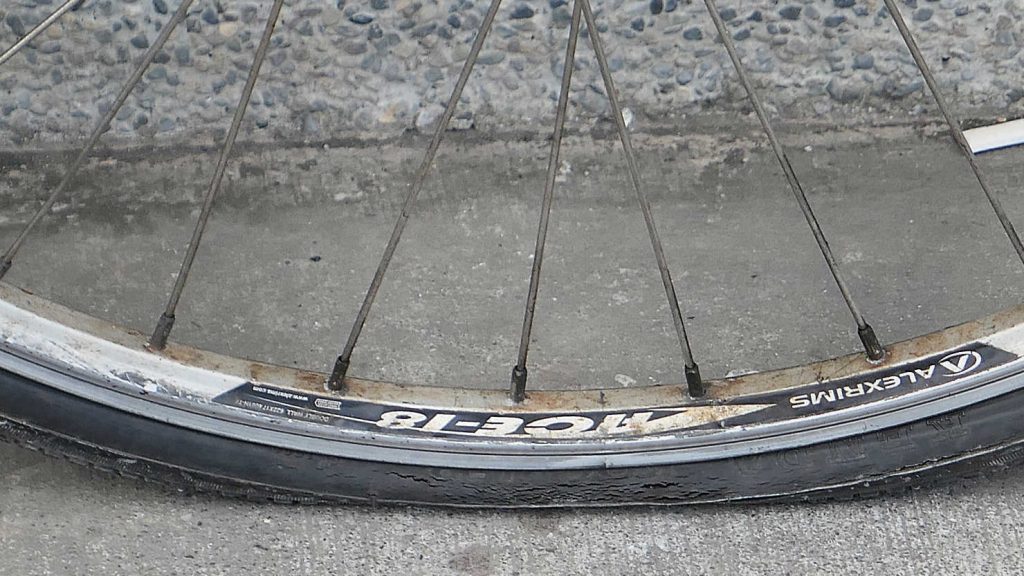
Closer view of the very used and very flat tire.

After pondering what we should do, we just so happened to find a business card in our backpack which had the bike rental shop phone number on it (we picked it up from the tourist information center in town and not from the rental shop). The man in the green shirt spoke some English and told us he would call the bike shop. In the meantime he told Rick to hop on his “Heineken” chopper bike to take it for a spin. He laughed and said “replacement bike”. He was kidding of course… A few minutes later, the restaurant owner came back and said the bike shop owner was coming to help us and to relax until he showed up. We weren’t sure what exactly coming to help meant, but we waited patiently inside the restaurant and enjoyed a cold beer. After roughly 45 minutes, the bike rental shop owner rode up on his scooter with a replacement bike which he had placed across his scooter seat!! Following a quick test run on the replacement bike, and him loading the damaged bike on his scooter, he motioned for us to follow him. So, we thanked the very friendly restaurant owner for all his help and hopped on our bikes. We followed the scooter all the way back to town as he wanted to show us a different section of bike path and also several sites along the way.
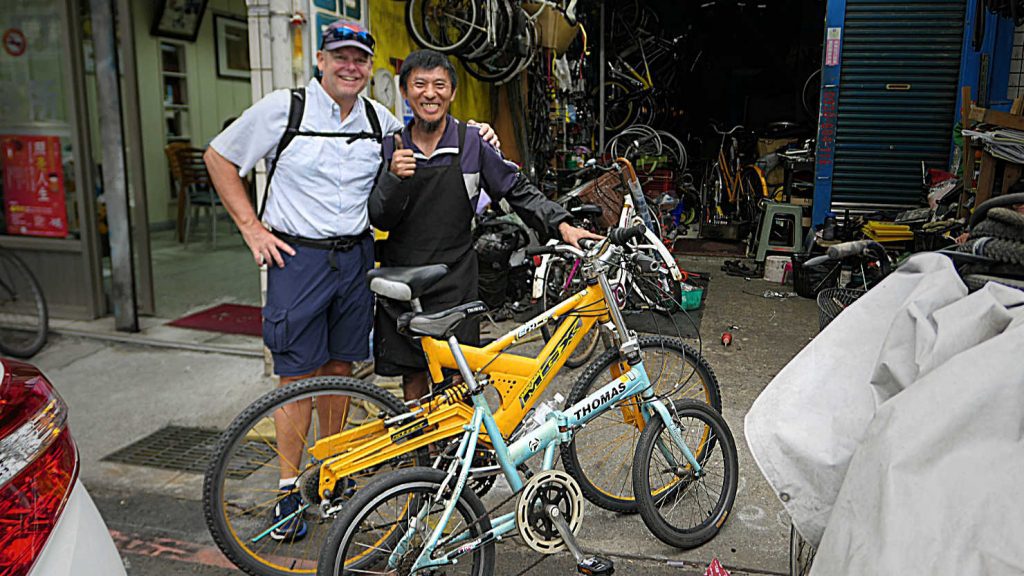
Rick and the bike shop owner back at his shop after our ride (he wanted a photo with us). He was so nice and kept saying he was sorry about the bikes. Even though we had a couple of hours delay on our bike ride, we ended up having a good time.
Hualien, Taiwan
Hualien was a fun city and area, but we had rainy weather on several of the days during our stay. We used the down time to catch up on computer work and research our next Taiwan destinations.
Bicycling the Waterfront Bike Paths in Hualien

Our bikes in Hualien. These bikes were name brand “Giant” bicycles and in much better condition than the previous ones we had rented in Yilan. Plus, the “Giant” brand bike shops give business cards with instructions to call them if any problems occur.

There are many bike paths in and around the Hualien area. We rode south for roughly an hour along this waterfront path. A local Taiwanese woman riding her road bike passed us, but quickly turned around to come back to talk to us and see if we needed any help or information. She told us if we rode another 20 minutes on the path we would see a very beautiful and scenic area. She rides this route all the time and wanted to show us the way. Within a few minutes of reaching our destination (roughly 5 miles or 8 km from where we started our day) the weather quickly turned and brought in dark clouds, high winds and a sharp drop in temperature. The three of us turned our bikes around and started a brutal ride back against the wind and weather. Our “new friend”, while a much faster rider, stopped and waited several times on the way back to town to ensure we were alright and didn’t get lost. She even showed us a different path through town to try and avoid the more harsh waterfront weather.

A second day of riding bikes on a different section of one of the bike paths. The weather was much nicer, and we even had blue skies.
We Even Found a Nice Treat in Hualien…Sushi

We found this little sushi house while walking around Hualien one day. We gazed and drooled through the windows before we went inside. We wondered how fresh it could be… As we watched for a few minutes, we saw many locals coming and going buying large amounts of sushi for take-away. We immediately saw the staff make fresh sushi to replace whatever was low. The sushi was all in glass refrigerated cases, but it never seemed to sit long enough to worry much about keeping the fish cool. None of the descriptions were written in English, but the sushi looked good so we decided to try it out. Wow, were we ever glad we did!!! The sushi was so fresh and delicious and super cheap too at 10 Taiwanese dollars per piece (roughly 30 cents US each).

Rick looking at all the different kinds of sushi deciding which to choose.

Our first plate of sushi (roughly $3.50 US). It was so good, we went back for a second plate and even a third 🙂 We spent 300 Taiwanese Dollars total (a little more than $10 US) and were both full and very happy. We haven’t had sushi for a very long time and never for this price. We went back a few more times over the rest of our stay in Hualien.
Video – Hualien (East Coast), Taiwan.
Taroko Gorge (East Coast), Taiwan
Taroko Gorge is one of nine national parks in Taiwan and is considered one of the countries most beautiful sites. This landmark gorge has tall, almost flat walls which were carved by the Liwu River. The area is also known for its abundant supply of marble, leading to its nickname, “The Marble Gorge”. While the area can be overcrowded with visitors, we were very fortunate to experience a relatively quiet day. Taroko is a must see for anyone coming to Taiwan – it has stunning scenery and is truly a marvel to see.
Shakadang Trail in Taroko Gorge

The starting point of the Shakadang hiking trail is at the Bridge of 100 Lions (lions are on the top white railing). This 4.4 km trail (one way) follows the crystal clear Shakadang River as it winds through marble canyons and boulder strewn flats. The curving riverbed creates massive pools of bluish-green water. The weather was perfect for our early morning hike.

Rick walking under a giant rock overhang on the Shakadang trail.

One of the massive pools of bluish-green water in the Shakadang River.
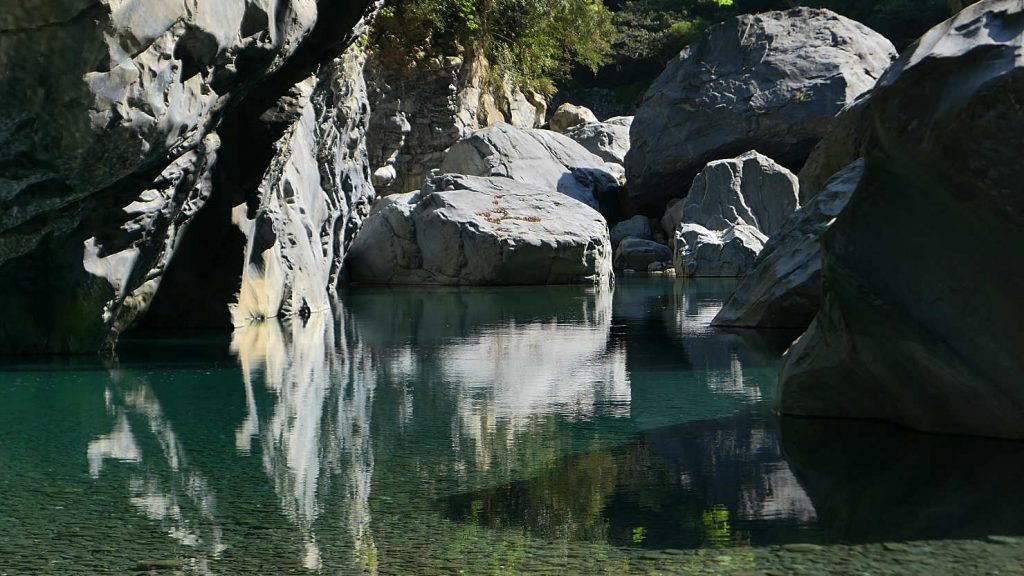
The marble wall reflecting in the extremely clear bluish-green water in the Shakadang River.

Rick and Alisa on the river along the Shakadang trail.

Marble wall along the Shakadang River.

We had to manage our time on the Shakadang trail in order to reach this bus stop in time to catch the next “Taroko Route” bus (it only comes every hour).

Here comes our bus to take us to our next destination, Swallow Grotto. The bus is an easy and relatively comfortable way to get from Hualien to Taroko Gorge. Driving yourself would certainly give more freedom from a time perspective, but dealing with parking and the crowds could definitely be an issue.
Swallow Grotto in Taroko Gorge

Rick walking through some of the large “blasted” rock tunnels at Swallow Grotto. You need to be careful as they allow cars to drive through these also.

Rick standing at the edge of the railing taking video looking down at Swallow Grotto.
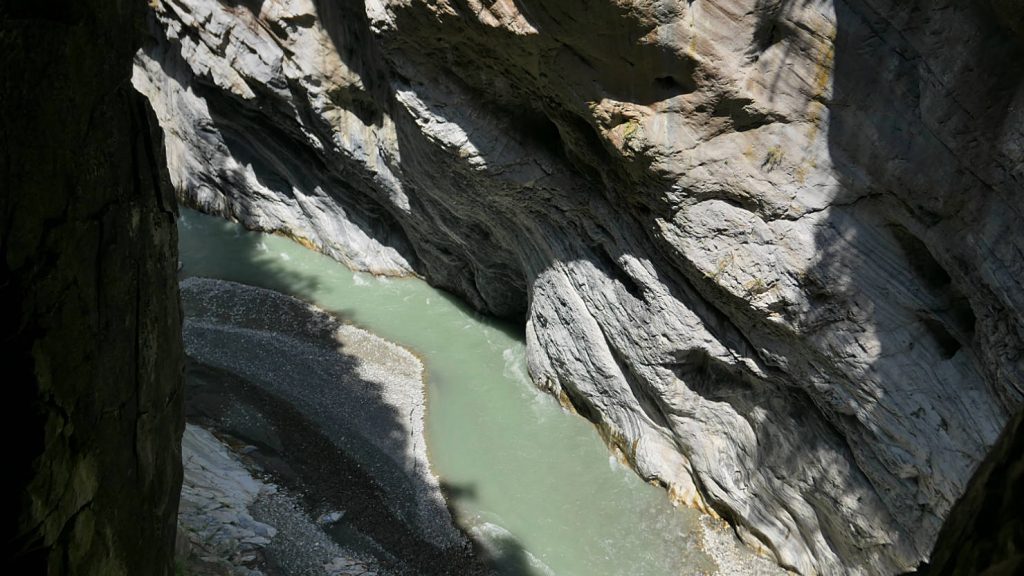
View looking down at the river in Swallow Grotto. The area is named for the large number of swallows which live in holes on the rock wall across the way. It was impossible to photograph the small swallows gliding around the gorge in the constant updraft.

View looking down at Swallow Grotto. This area has a constant seepage which comes through the rock wall and is not drainage from above.

A large face has been created on the rock wall across the way by natural erosion. It’s said to resemble an Indian wearing a head dress.

Narrow “S-Bend” in Swallow Grotto.

The Taroko road is a marvel in an of itself…you can see how they blasted tunnels and cut the road directly into the side of the gorge. The entire Taroko road system requires constant maintenance. We had several hours of delays during our visit as a portion of the road was reduced to one lane. Workers would clear debris for about an hour (while traffic waited on each end) and would then allow each direction of traffic to move through one at a time.
Video – Taroko Gorge (East Coast), Taiwan.
Yuli (East Coast), Taiwan
Yuli is a small rural agricultural town with several interesting things to see and do nearby.

Our train arriving to take us to Yuli town.

Rick on the train surrounded by the cute Taiwanese mascot, “Bravo” the black bear. You see “Bravo” the black bear everywhere 🙂

Upon arrival to the Yuli train station, everyone is greeted by “Bravo” the black bear. Here he’s holding a hand tool for working in the rice fields.

“Bravo” the black bear holding a bowl of Yuli noodles, the town’s signature dish.

Our very tasty bowl of Yuli Noodles.

“Bravo” the black bear showcasing the last remaining mobile post office in Yuli.
Tectonic Plate Convergence on the Love Bridge in Yuli

A unique spot on the “Love Bridge” in Yuli where the Philippine Sea Plate and the Eurasian Plate meet. The land east of the waterway, including the Coastal Mountain Range, is part of the Philippine Sea Plate. Everything to the west is part of the Eurasian Plate. East Taiwan’s hot springs and frequent earthquake tremors and much of its rugged beauty can be attributed to the ongoing collision between these plates. This marker point is 1 of only 2 in the world where a bridge crosses a plate convergence (the other is in Iceland).

Rick and Alisa at the Philippine Sea Plate and the Eurasian Plate convergence.

The Love Bridge where the Tectonic Plates converge, also the Yuli-Fuli bikeway.
Walami Trail near Yuli
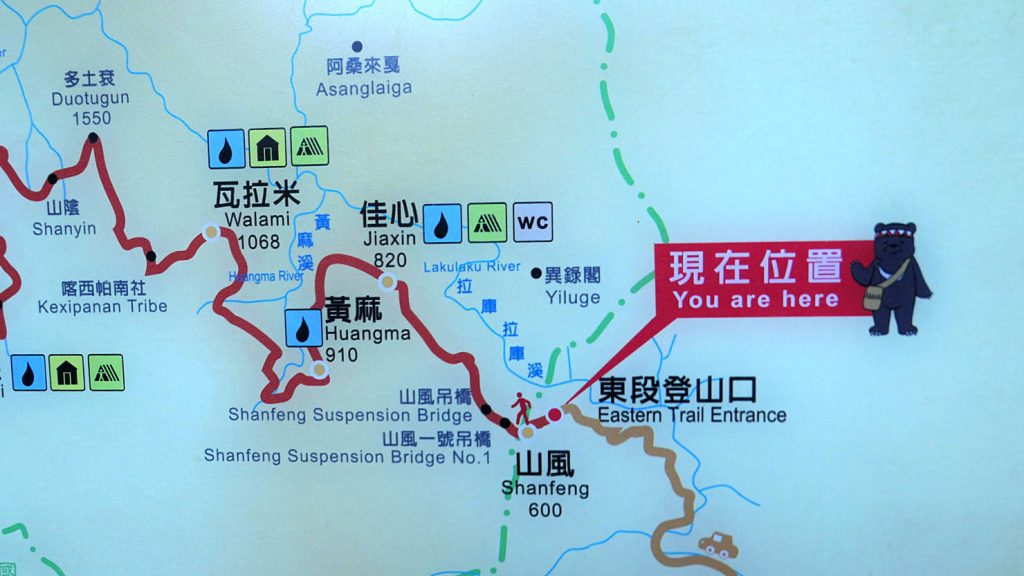
Here’s “Bravo” the black bear again, this time he’s showing us where we are on the Walami Trail map. We hiked the shorter “non-permitted” Jiaxin section of the Walami Trail. The full trail requires permits which need to be applied for in advance.

The first of two suspension bridges along the trail.

The second bridge was built by the Japanese during their occupation of Taiwan.

A rock overhang above a narrow section of the Walami trail. The trail was a great way to spend half a day in the wilderness.

Panorama view from the Walami trail of the surrounding area.

View from a high point on the Walami trail.
Tropic of Cancer Marker Point near Ruisui (a 15 minute train ride from Yuli)

This taxi was the only one at the Ruisui Train Station upon our arrival. The driver did NOT speak or understand any English. To convey our request, we used google translate, which only sometimes helps (in this case it didn’t), we then showed the driver a map and pointed to our intended destination, and lastly, we asked a couple of young girls who spoke some broken English to help translate. But, after all of our efforts, we were NOT at all confident he understood our request as we got into the car…
Our goal was for him to drive us to the Tropic of Cancer marker point, wait for us for roughly 20 minutes (as we looked around and took photographs), and then take us to our accommodation in Ruisui. As there were no other options for transportation, we rolled the dice and hoped he understood what we had asked for.
Well, needless to say – this photo is not taken at the Tropic of Cancer Markerpoint, but at another ancient stone pillar attraction nearby. We were wondering if we’d made a mistake by hopping in the taxi, but as luck would have it another car drove by and stopped. The driver spoke good English and translated our request to the taxi driver and in minutes we were back on our way.

We finally made it to the Tropic of Cancer Marker point. The Tropic of Cancer, the circle marking the latitude 23.5 degrees north, is the Northern Hemisphere’s furthest location from the Equator that can experience the sun being directly overhead. Every summer on June 22, the sun is directly over the Tropic of Cancer. This “shadowless” effect that takes place at noon is the Tropic of Cancer’s unique astronomical phenomenon.

Another view of the Tropic of Cancer Marker point.

The sundial at the Tropic of Cancer Marker point. It was quite accurate if you look at the shadow, we arrived at 1:05pm.
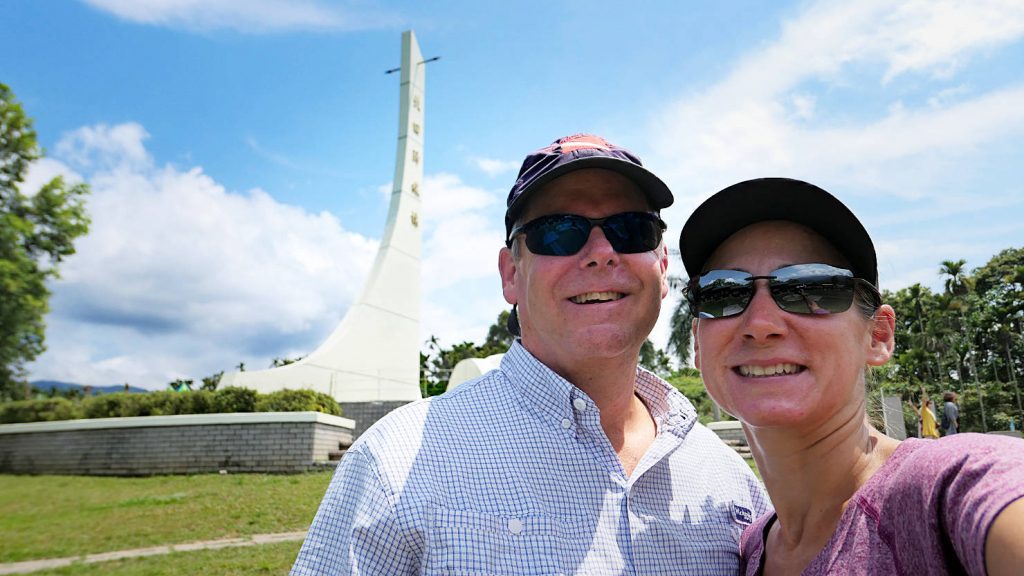
Rick and Alisa at the Tropic of Cancer Marker point.
Video – Yuli & Ruisui (East Coast), Taiwan.
Our Dinner in Ruisui

Rick sitting at the local restaurant in Ruisui we had chosen for dinner.

This is the wall menu at the Ruisui restaurant. We were unable to decipher any of it as Google translate does not work on handwritten characters. The owners knew we wanted to eat, so they simply walked Rick into their kitchen and pointed out some of the fresh ingredients used in making their dishes.

Not knowing at all what we had ordered, this was the dish they made us for dinner. It was a sort of noodle dish with ground pork, noodles, fresh vegetables, in a broth. We were very pleased as it ended up being delicious.
Sanxiantai (East Coast), Taiwan
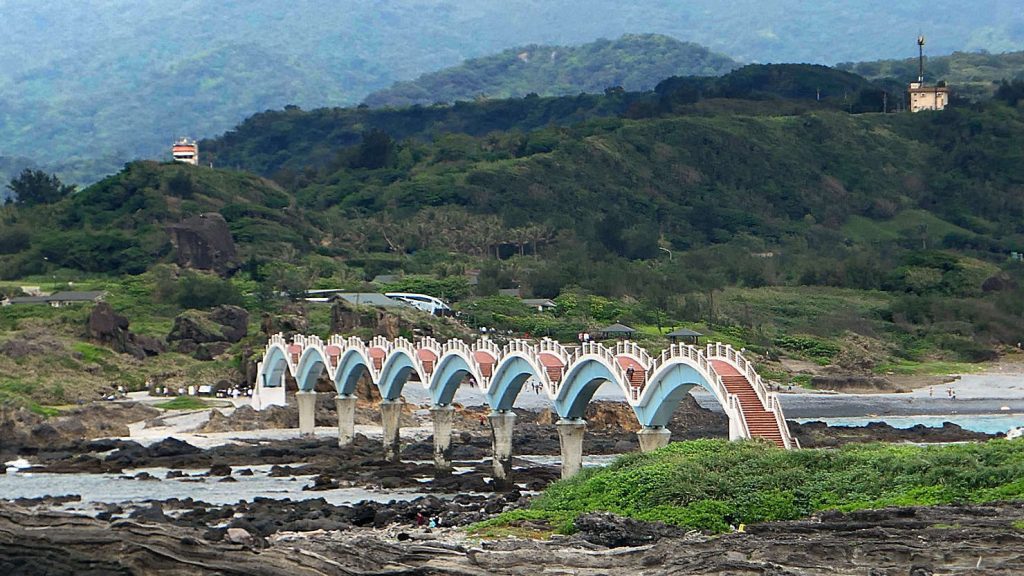
The Sanxiantai bridge is the most famous landmark on the East Coast of Taiwan and is composed of offshore islands and coral reefs.
Sanxiantai Bridge and Island

The island used to be part of the mainland, but due to strong weathering it rapidly became an island. The bridge was built in 1980 and symbolizes a sea dragon to connect the mainland to the island. Prior to the bridge, the island could only be reached at low tide. Surprisingly, the majority of tourists don’t go any farther than a photo-op at the head of the bridge. We witnessed this first hand as we spent several hours on the island and only saw a few local fisherman and tourists.

Sanxiantai Bridge and island from the mainland.

Another view of the Sanxiantai Bridge and island from the mainland.

View of the island from the top of the Sanxiantai Bridge.

Rick and Alisa on the island getting ready to walk to the other side.

Walking path on the island with the Sanxiantai Bridge in the background.
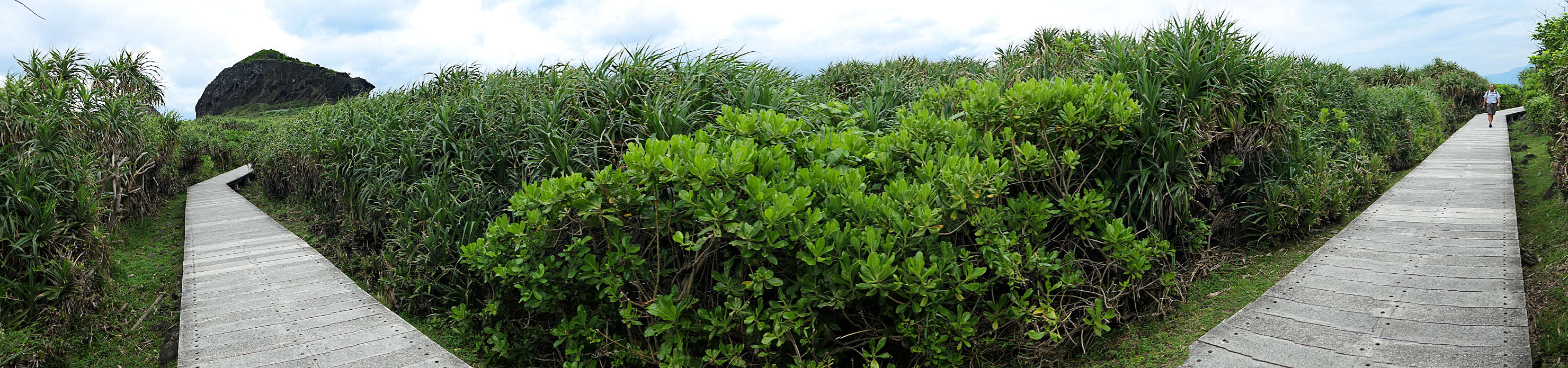
Panorama of the walking path leading to the other side of the island.

Panorama looking toward the opposite end of the island.

Stairs leading up the Sanxiantai Lighthouse, located on the far side of the island opposite the bridge.

View looking down from the Sanxiantai Lighthouse.

View from the Sanxiantai Lighthouse.

Rick and Alisa at the Sanxiantai Lighthouse.

Panorama view from Sanxiantai island looking toward the mainland. You can see the Sanxiantai Bridge in the distance.