
Hill Country, Sri Lanka – Feb 2018
Sri Lanka was not a country on our radar as a place to visit, but over the last year we’ve met several travelers who recommended it. So, we decided to add it to our itinerary and check it out.
Since the war ended in Sri Lanka (2008), the country’s popularity among travelers has been increasing year over year. The busy tourism industry has brought increased entrance fees at national parks for foreigners and combined tourist taxes and service charges of 30% at many hotels and restaurants. Despite all this, there are still places worth seeing ranging from very old historical sites dating back several thousand years to lush tea covered highlands to beautiful coastal areas and beaches.
Our first few weeks, we elected to take one of the recommended train rides into the “Hill Country” to visit the “Lion Rock” world heritage site in Sigiriya, Kaudulla National Park, the “Ancient City” world heritage site of Polonnaruwa, and a small hiking area around Elkaduwa.
See video and photos below highlighting our days in the “Hill Country” of Sri Lanka. To see all images of this location click the link at the bottom of this post or go to our gallery.
Video – Train Ride (Colombo to Kandy), Sri Lanka. Riding a train across Sri Lanka is recommended as a casual and scenic way to travel if you have to ability to reserve seats 😉

Rick taking video of where we sat in the Observation Car on our train from Colombo to Kandy. The trains in Sri Lanka are very popular with locals and tourists and are usually booked several weeks out. We had to book our seats 30 days before our arrival.

Rick and Alisa at the Kandy Train station waiting to be picked up for our 2+ hour ride to Sigiriya.
“Lion Rock” – Sigiriya, Sri Lanka
The Sigiriya “Lion Rock”, a world heritage site, is where King Kasyapa built his palace on the summit from 477-495 AD to protect his kingdom from an impending invasion by his exiled brother. The “Lion Rock” is 180 meters (590 ft.) high with 3.7 acres on the top. Today, the summit is reached by climbing a combination of stone steps, circular staircases and steel steps bolted to the rock face. Once at the top you are rewarded with a 360 degree view of the surrounding semi-highland zone and the small village of Sigiriya.
Today, all that remains of the palace is a series of foundations, water storage facilities and remains of the Royal Bath. Remnants of the Royal City surrounding the base of the rock include water gardens, terraced gardens and boulder gardens where ritualistic features have been carved out of solid rock including thrones, cisterns and an “Audience Hall”.

View of “Lion Rock” from our guesthouse. It was amazing to see this 590 ft tall massive rock from this distance prior to actually climbing it. It’s hard to believe a King actually built his palace on the top.

One set of stone steps through the boulder garden up to one of several terraces which lead up to the “Lion Terrace” entrance and staircase to the summit.

Circular staircase leading up to the few remaining original Sigiriya Damsel paintings. To protect what’s left of the beautiful paintings, they do not allow any photos or video while on the viewing platform.
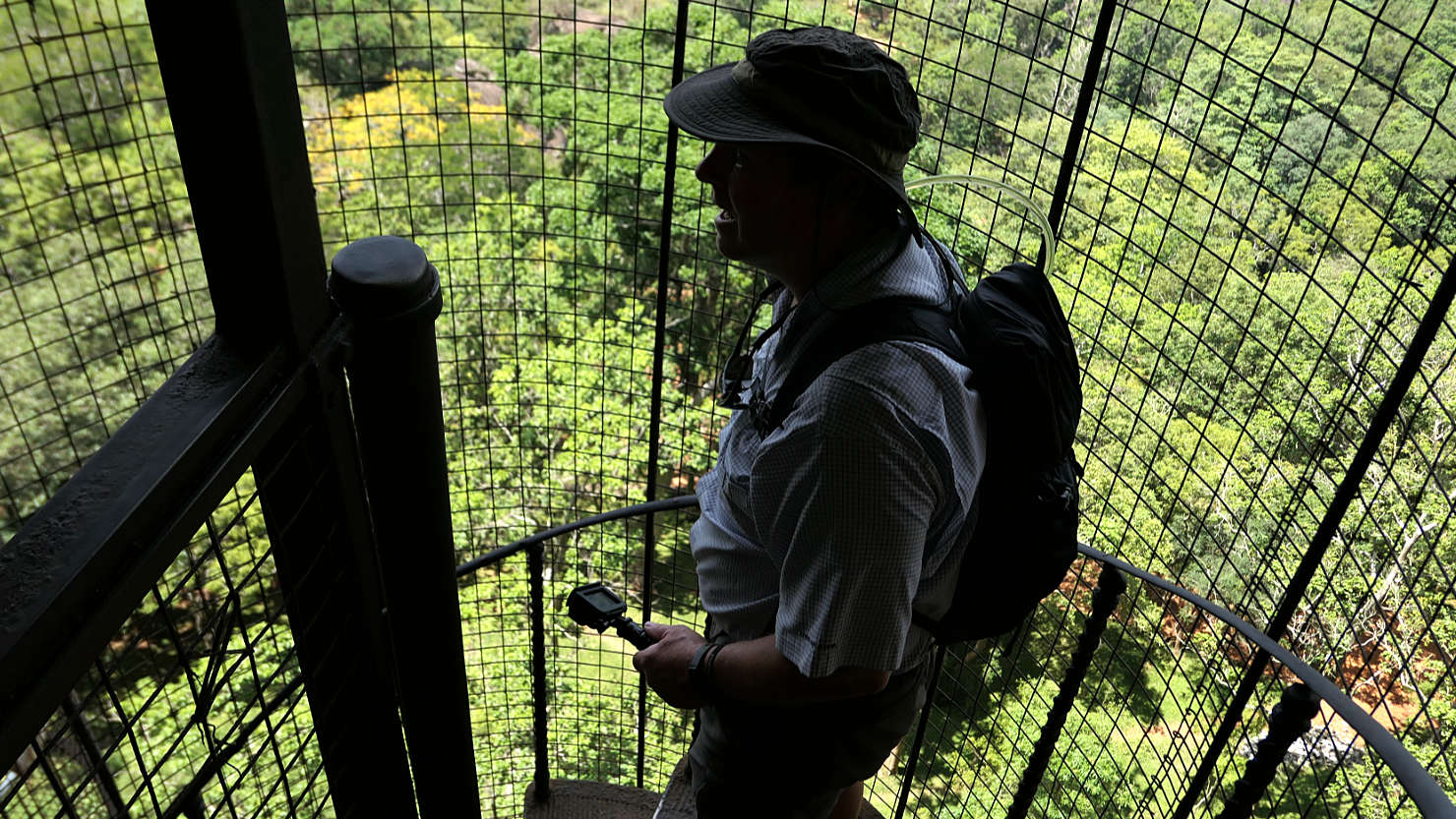
Rick going down the very high circular staircase. The staircase was bolted to the rock and seemed sturdy, but it was still a little unnerving as we had already climbed up several staircases to reach the start of this one.

One section of steel walkway bolted to the side of the rock. This walkway leads up to the “Lion Terrace” entrance and staircase to the summit. For size comparison, you can see a bunch of school kids walking on the platform.

The Lion’s Feet and staircase leading to the summit. The feet are massive. You can see the size of the people in the photo as comparison. It’s believed there was once a full lion’s head. The steps were thought to have passed through the lion’s mouth as one entered the palace at the top.

View from part way up the staircase looking down toward the lion’s feet.

From higher up on the staircase, view looking down toward the lion’s feet.

Rick and Alisa at the summit of Lion Rock with a view of Sigiriya in the distance.

One of the many resident macaques. All of these monkeys had what looked like very funny toupee-like hairstyles 😉

Resident macaque walking a fence with a view of Sigiriya in the distance.
Panoramas from the top of Lion Rock
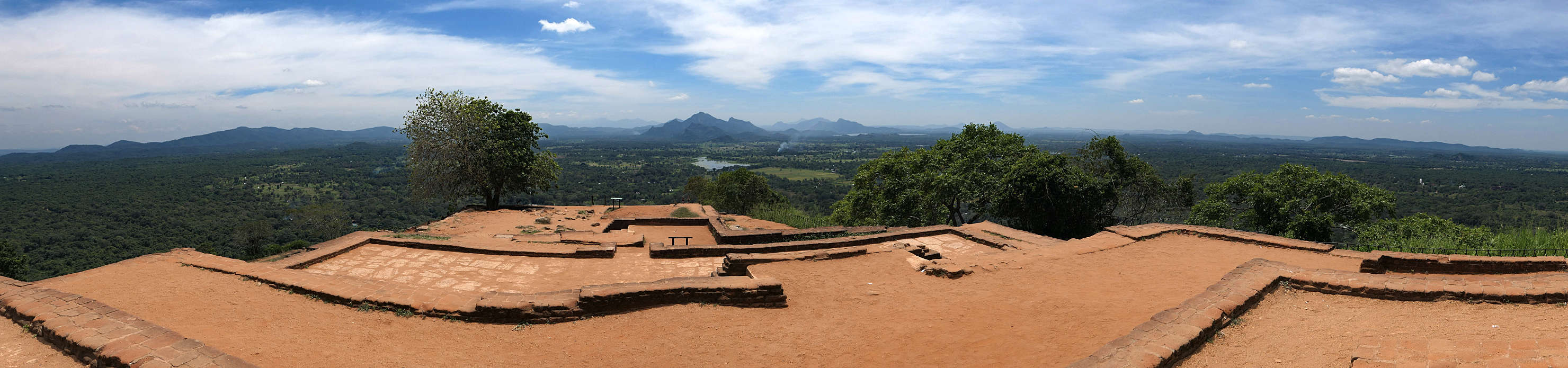
What remains of several foundations.

The Royal Bath.

Another view showing remaining foundations and some of the terraced areas of the palace.
Video – Sigiriya (Lion Rock), Sri Lanka
Kaudulla National Park, Sri Lanka
Kaudulla National Park was opened in 2002 and is centered around the ancient Kaudulla Tank (reservoir). During certain times of the year, its possible to see large groups of wild Asian Elephants up close and grazing around the tank. Per guide books and online information, we didn’t think they would be around during our visit, but we were wrong! Upon our arrival into Sigiriya, we were told the elephant groups were hanging out in the Kaudulla National Park tank area and now was a good time to see them! So, we booked a half day jeep safari.

Our ride picking us up for our safari to Kaudulla National Park.

Our jeep for our safari through the national park. Our guide pulled the canvas top off and we had the entire back to ourselves.

As we drove near the reservoir, we came upon roughly 150 wild Asian Elephants grazing. There were too many of them to all fit in one photo.

One of the groups separated from the others in the distance.

We were able to continue to drive closer. It was amazing to see so many wild elephants all in one place. We’ve seen one or two in the wild before, but nothing ever like this!

Most of them hung out in smaller groups as they moved around.

They were very fun to watch as they continuously picked grass, swung their trunks back and forth to remove the sand, and then ate the grass.

This group had several adults, juveniles, and a baby.

Close-up of a large adult, several juveniles, and a baby.
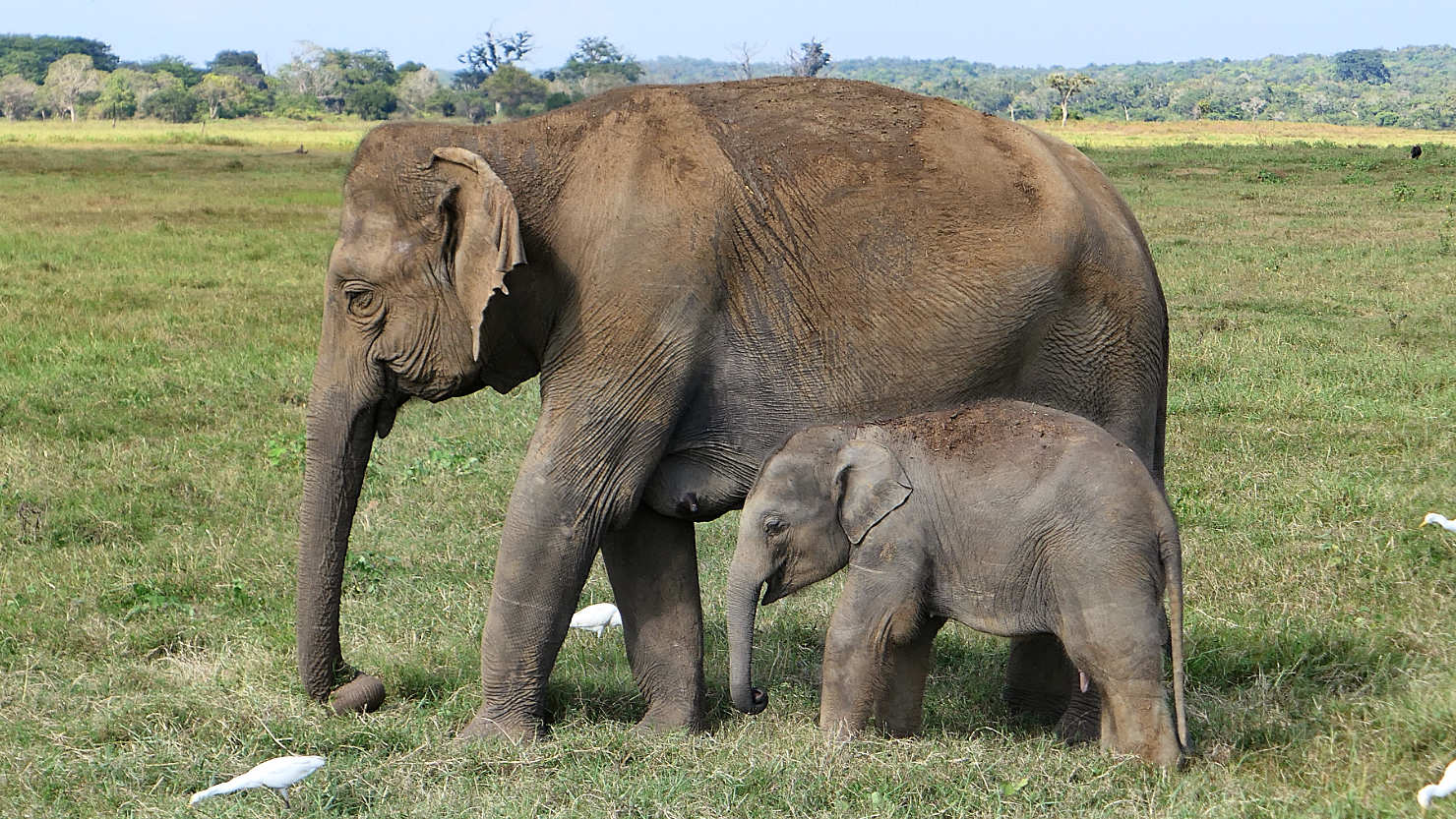
Momma with her baby.

We drove to a different area of the park and came across another group of 50+ elephants.

This group had an extremely small and very young baby. The baby never got more than a few feet from it’s mom and juvenile siblings.

We were able to get within a few feet of many of the elephants. It was cool to be able to get so close to so many of them.
Video – Kaudulla National Park, Sri Lanka
Polonnaruwa, Sri Lanka
The World Heritage Site of Polonnaruwa is located in North Central Sri Lanka. It became the island’s second great capital in the medieval era (11th-13th centuries A.D.). Today, the ancient city of Polonnaruwa offers a glimpse into the life and times of medieval Sri Lanka. The city sets amidst old forests and lush grasslands. Riding bicycles throughout the area was a nice way to see the ancient city and great way to spend a day. Well, a little over half a day as there were several torrential downpours which caused us to start our day late and end our day early.

Shortly after breakfast in Polonnaruwa, we had a torrential downpour. This was the view from our patio. We waited for well over an hour for it to lighten up and stop before we ventured out on our bikes to explore the ancient city.

Our transportation around the ancient city.

The Royal Palace. This is what remains of the seven story structure.

Exterior of the Council Chambers.

The Royal Bath.

Another view of the Royal Bath.

Vatadage Circular Relic House.

One of several Buddhas inside the Vatadage Circular Relic House. The Buddhas all sit in a circle in the center of the Vatadage facing outward. Each one sits at the top of the stairs as you enter the house. It’s a sign of disrespect to have your back toward any buddha. In fact, it’s illegal to do so…there are signs posted at every temple containing a Buddha in Sri Lanka letting all tourists know “selfies in front of any Buddha is illegal and not permitted”.

Carved sculpture detail on the step risers of the Vatadage Circular Relic House.
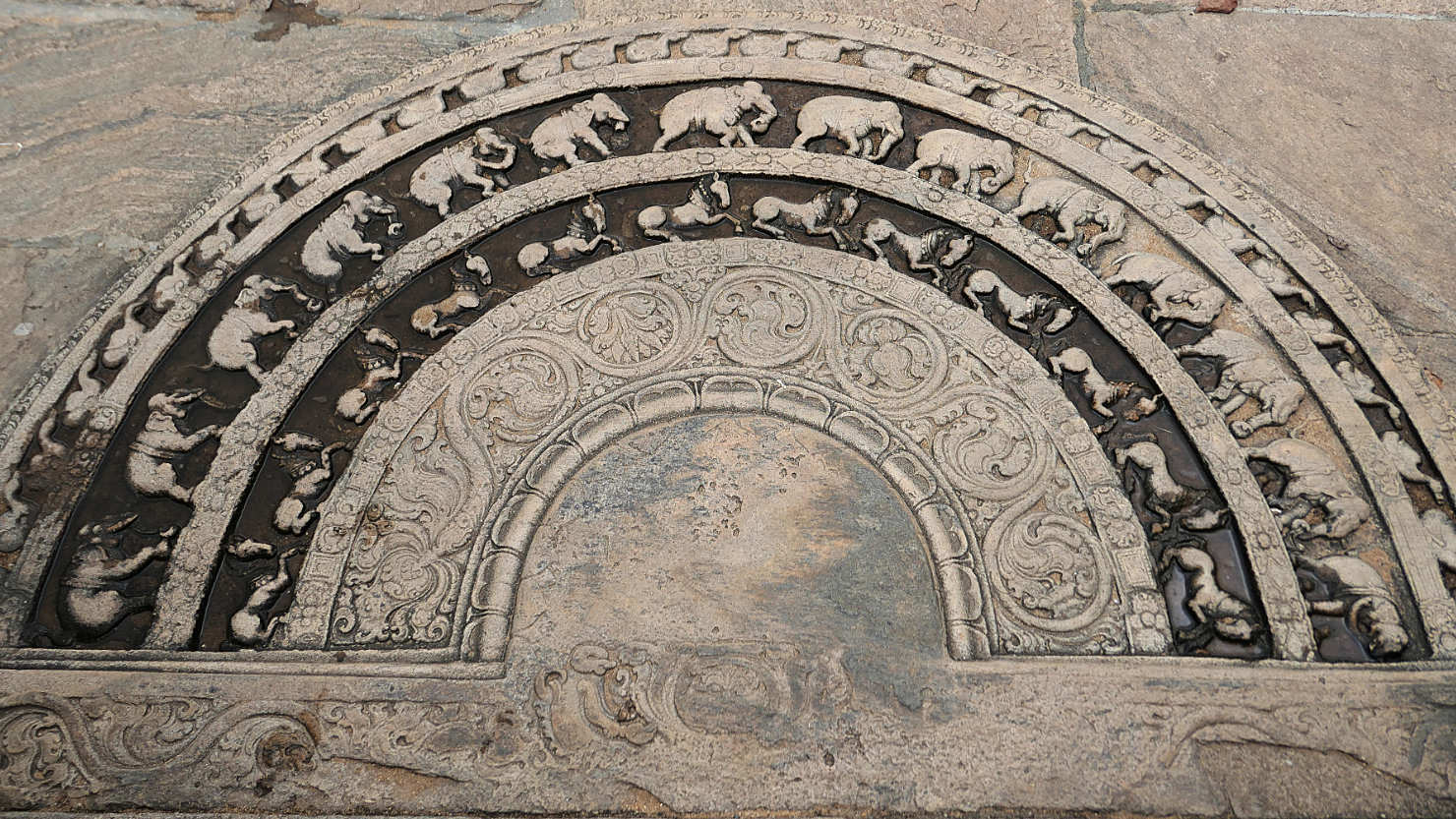
Moonstone at the base of the steps of the Vatadage Circular Relic House.

Exterior of the Atadage, the oldest building at Polonnaruwa.

Gal Pota Book of Stone. This is a single granite slab weighing 25 tons. The slab was moved 56 miles from it’s mined location to it’s current location where it’s inscription was carved.
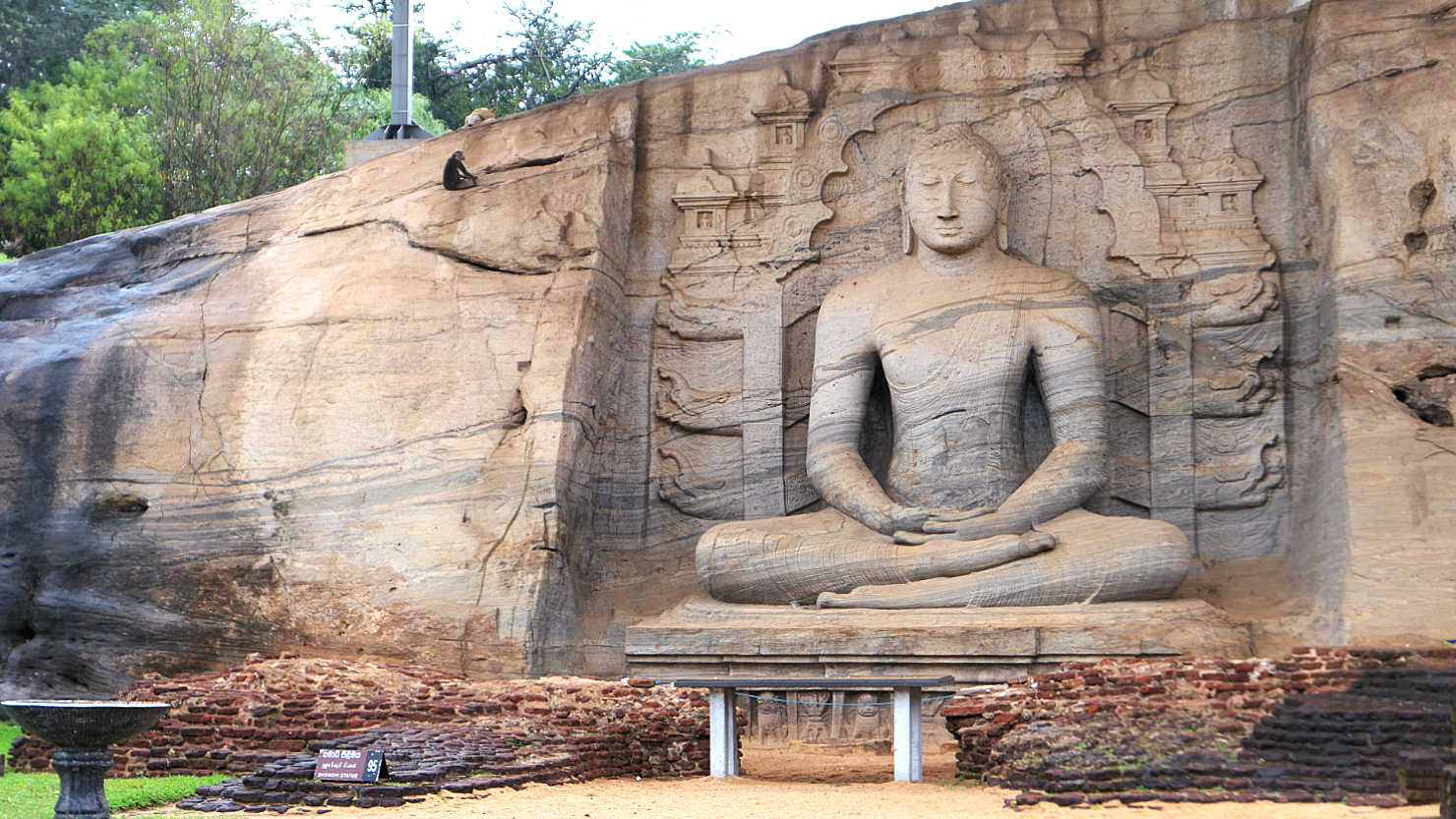
Gal Vihara. This carving was very large and impressive and contained 3 sculptures of Buddha. This was only the left portion of the carving as it was too large to get the entire sculpture in one photo due to the limited space. For size comparison, you can see a monkey on the stone to the left near the top.
Gal Vihara was our last stop in the ancient city. There was more we had planned to see, but an afternoon thunderstorm rolled in. We rode around in the downpour until we were completely soaked and called it a day when there was no end in sight. We finished the day riding our bikes in several inches of standing water on the roadways. The standing water was not because their drainage systems didn’t work, it was because it rained so hard the drains could not keep up.
Video – Polonnaruwa, Sri Lanka
Elkaduwa, Sri Lanka
Elkaduwa…well, there isn’t much to describe the small town. We thought Elkaduwa was a place located near good hiking trails, but as it turned out it was not close to much. We were very high up a mountain road in an accommodation which simply put was very strange and eery, as it was all but deserted. We did find one hike up the road from the hotel which took us over the mountain and through several small villages before winding down the other side. The hike was very nice and took us through beautiful tea plantations with mountain views along the way.

While walking along the road, we came across this local man washing his Tuk Tuk. He was very eager to talk to us.
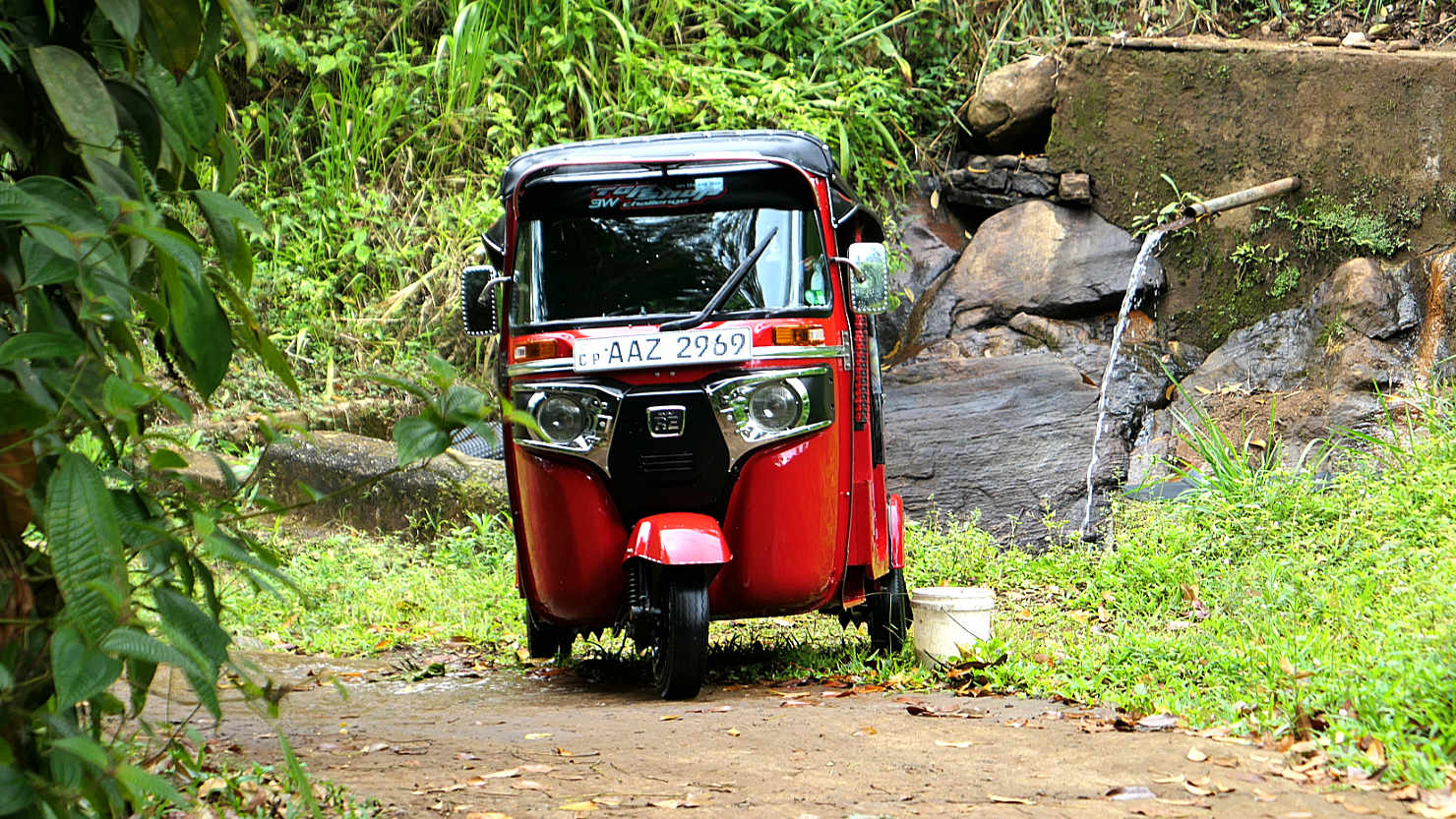
His sparkling clean Tuk Tuk. The water coming out of the pipe is coming from a local creek.

The road we hiked up and through the tea plantations.
Video – Hike around Elkaduwa area of Sri Lanka

We could hear loud music playing as we walked through one of the small villages. As we got high enough to see what was going on…we could see these local school kids rehearsing a dance to the music for some kind of upcoming celebration. The adults sitting up above on the left waved hello to us as they saw us watching the performance.

Nearing the end of our hike, we were hit with another torrential downpour. A local elderly man called us into his small cinnamon factory for cover from the storm. What he called a “factory” was more like a shack where young men sat and peeled cinnamon bark from limbs. This view is looking out the doorway of the shack at the rain – the wood you see is now firewood as it has already been harvested of it’s cinnamon bark. This time of year is considered dry season, and apparently all this precipitation is very unusual.
Sri Lankan Food
The local Sri Lankan food was absolutely delicious. Totally different from anything we’ve had to date. The food is cooked with many locally grown spices creating a very unique taste with a ton of flavor. You do have to be careful with very local food as they like it very, very spicy. Here is a sampling of a few of our favorite dishes so far.

Plain and Egg Hoppers, part of our Sri Lankan breakfast. Hoppers are crispy, bowl shaped pancakes made with rice flour. They are a local favorite and come in many varieties. Super good!

Sweet Sri Lankan Pancakes. The pancake is made with turmeric and is more like a thick crepe with a coconut and sugar filling. These were fantastic.

Another Sri Lankan breakfast. Roti with egg and dahl curry and string pancakes. The string pancakes look strange, but they are good. They’re covered with noodles with coconut and sugar in the middle, the same filling as the sweet pancakes.
