
Java, Indonesia – Sept 2017
After spending 2 months traveling across the Indonesian Islands of Lombok, Sumbawa, and Flores, our 60 day visa was near its expiration. However, we were not quite finished with our “must-see’s” in the country. So, in order to restart our “immigration clock”, we opted for a short “border hop” flight to Singapore for a few days. This allowed us to receive another 30 day visa upon arriving back in Indonesia to continue our journey.
At the end of August, we arrived in Yogyakarta, Indonesia which is located in the central portion of the island of Java. The island of Java is considerably larger and is the most populated island in Indonesia. Java also has very developed and modern areas in the larger cities, but unfortunately it doesn’t have a developed road system to match. Many of the roads are single lane which have the potential for some extremely long traffic delays during overland travel. Based on the sheer number of people living on Java, we had anticipated the roads and overland travel may be a challenge during our time here. But, we had 4 places we really wanted to visit and we were willing to deal with the potential inconveniences of the travel to reach each of our destinations.
Over the next 14 days, we visited locations in Central and Eastern Java. See our below post for details about each area visited.
See video and photos below highlighting our days spent around the island of Java, Indonesia. To see all images of this location click the link at the bottom of this post or go to our gallery.
Yogyakarta, Central Java
Yogyakarta, most often simply called “Jogja”, is a developed urban city known for its traditional arts and cultural heritage. While we loved our past months traveling among less developed areas, Jogja was a nice change offering a very comfortable atmosphere and vibe. The people here seem to love their city and what it has to offer. This was evident by the overwhelmingly cordial people and the level of customer service provided everywhere we went.
Video – Yogyakarta (Misc), Indonesia (Java)
Kopi Luwak
Kopi Luwak, or civet coffee, is a form of processing rather than a variety of coffee and has been called one of the most expensive coffees in the world. This type of processing includes part-digested coffee cherries eaten and defecated by the Asian palm civet. This sounds disgusting, but the coffee beans are washed, roasted and brewed before they hit your coffee cup. In Java, there are coffee houses who process their coffee using civet farms and some who gather the partially digested coffee beans from civets in the wild. We visited both types of coffee facilities. The “in-house civet” coffee house we visited seemed to provide the civets a good living environment. The civets are let out of their cages individually to wander freely around their facility. And after a few years, the civets are then released back into the wild. The civets themselves are very interesting to see in person. And, as coffee lovers, once we learned about the process we had to try the coffee. We tasted a cup of the Kopi Luwak Robusta and Arabica… both were very delicious.

Kopi Luwak coffee house. This facility processes their coffee using in-house civets.
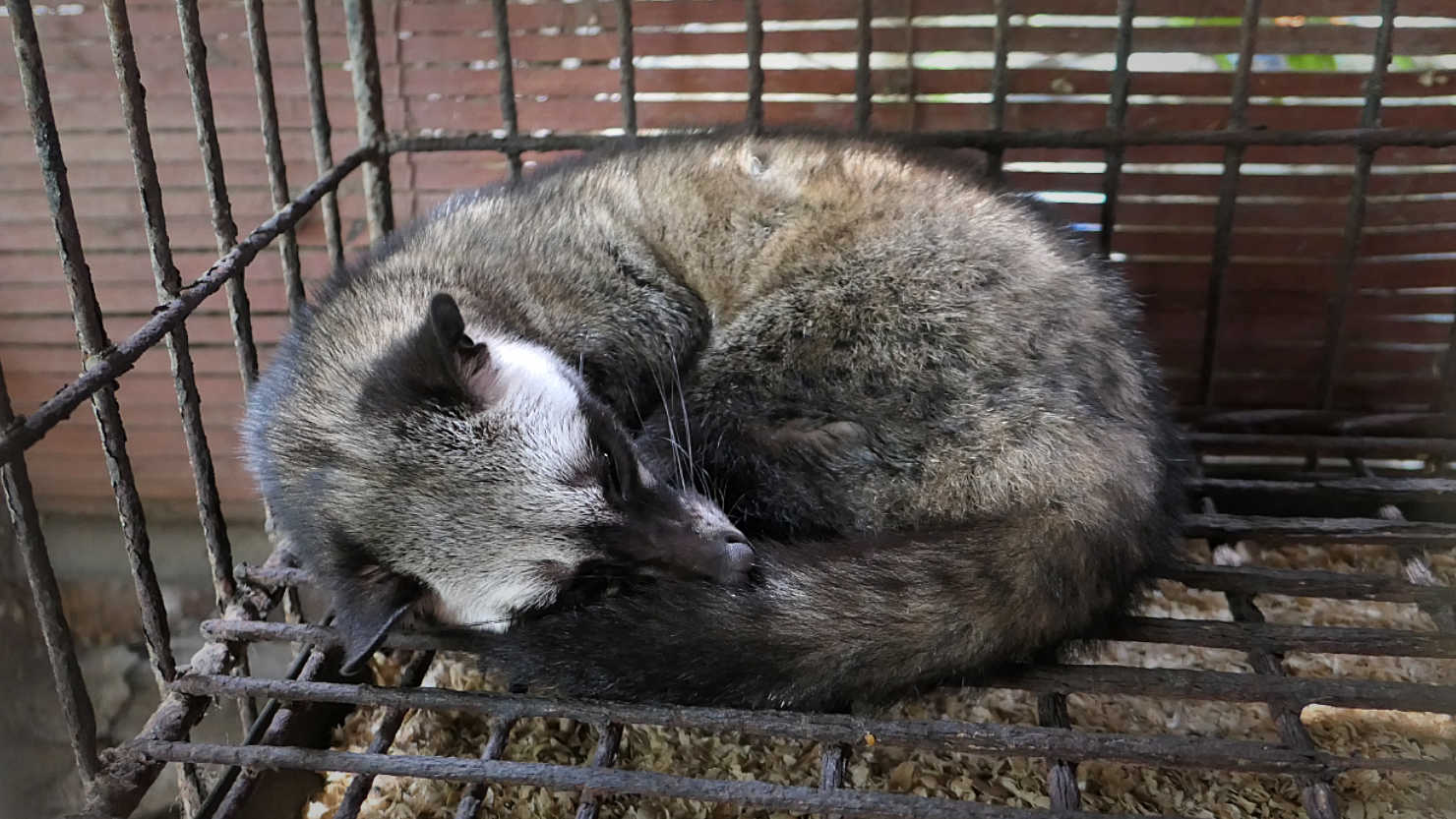
One of the asian palm civets taking a nap.
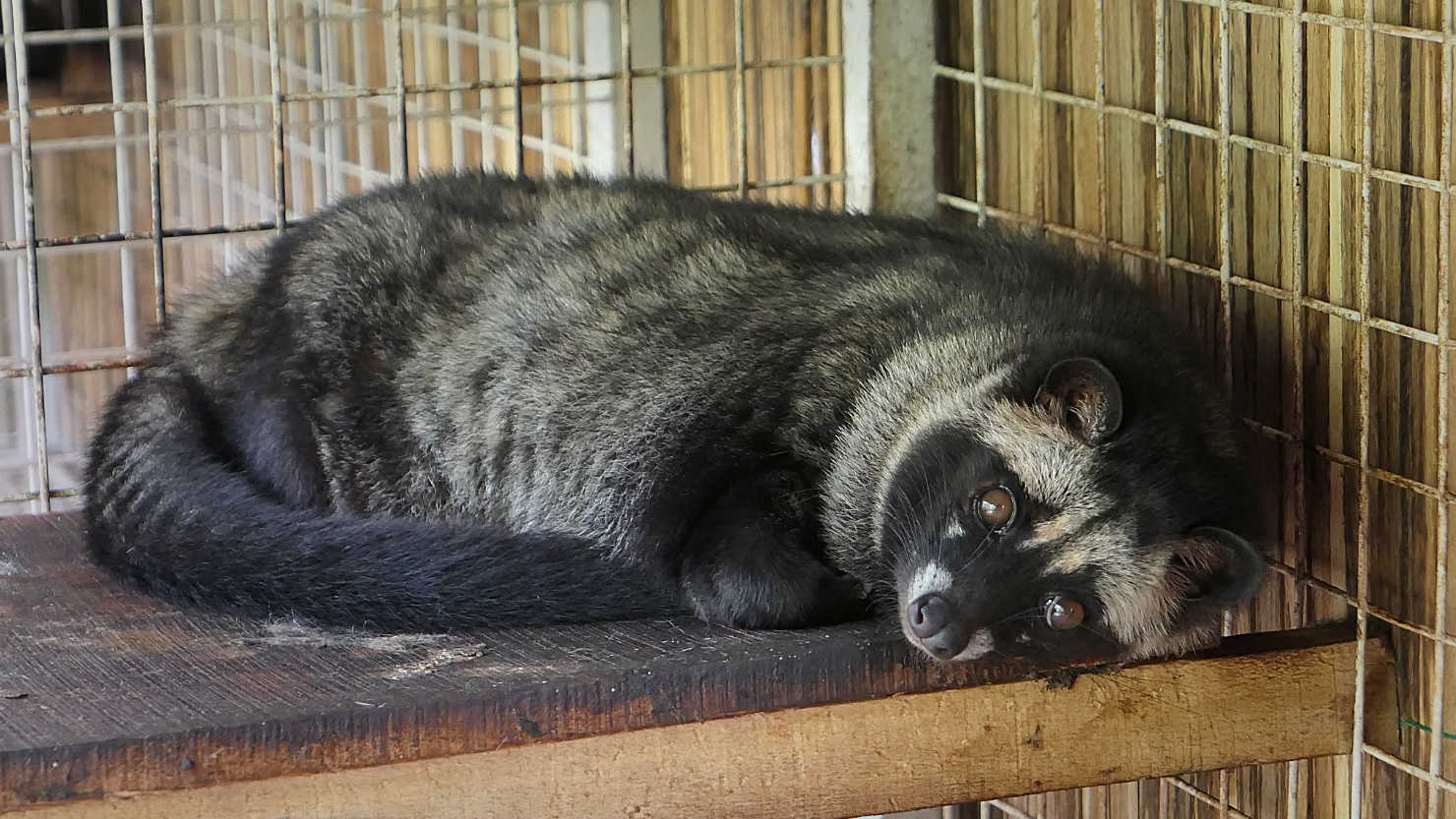
This asian palm civet was checking us out.
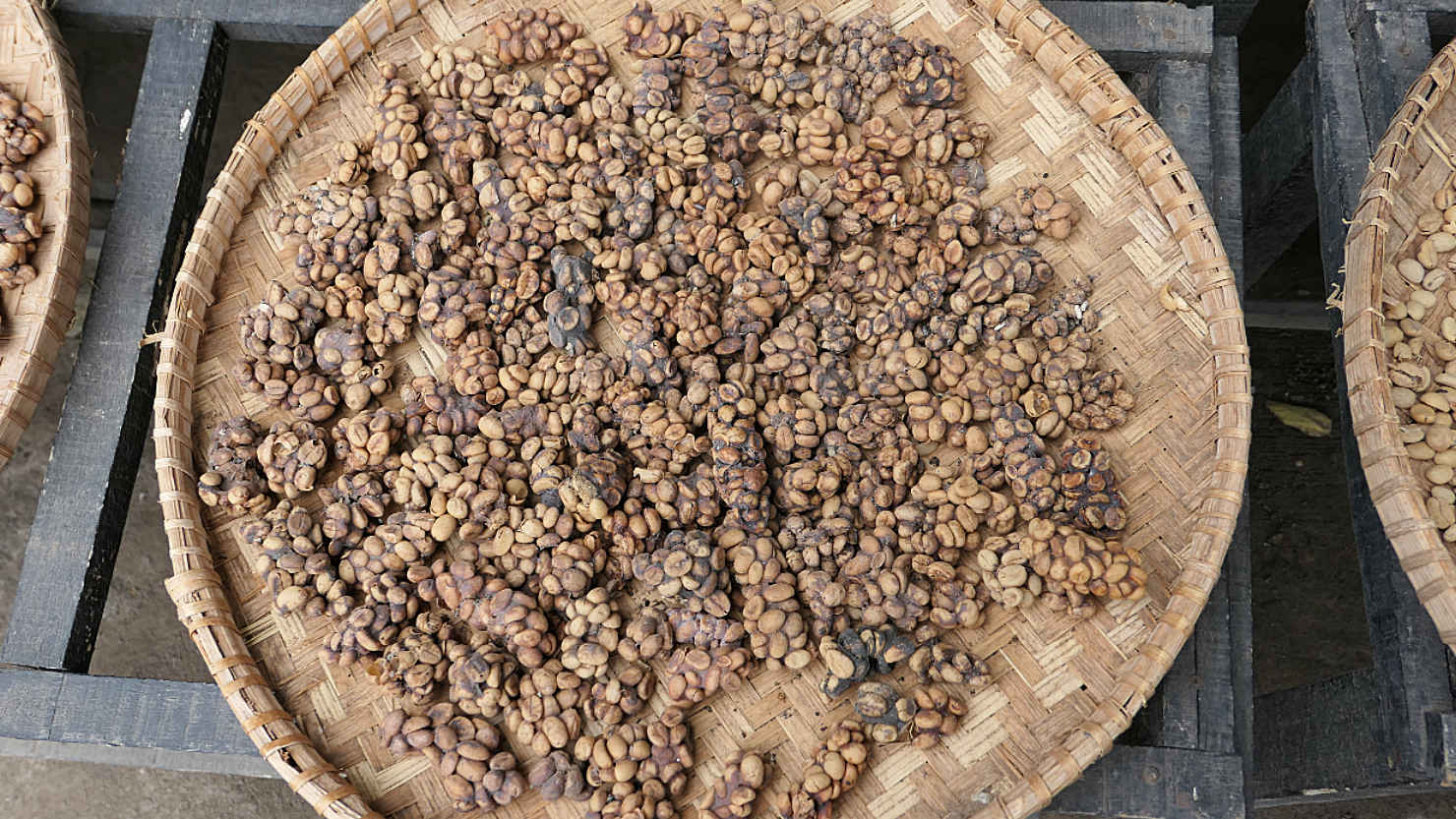
Dried clumps of partially digested coffee beans.
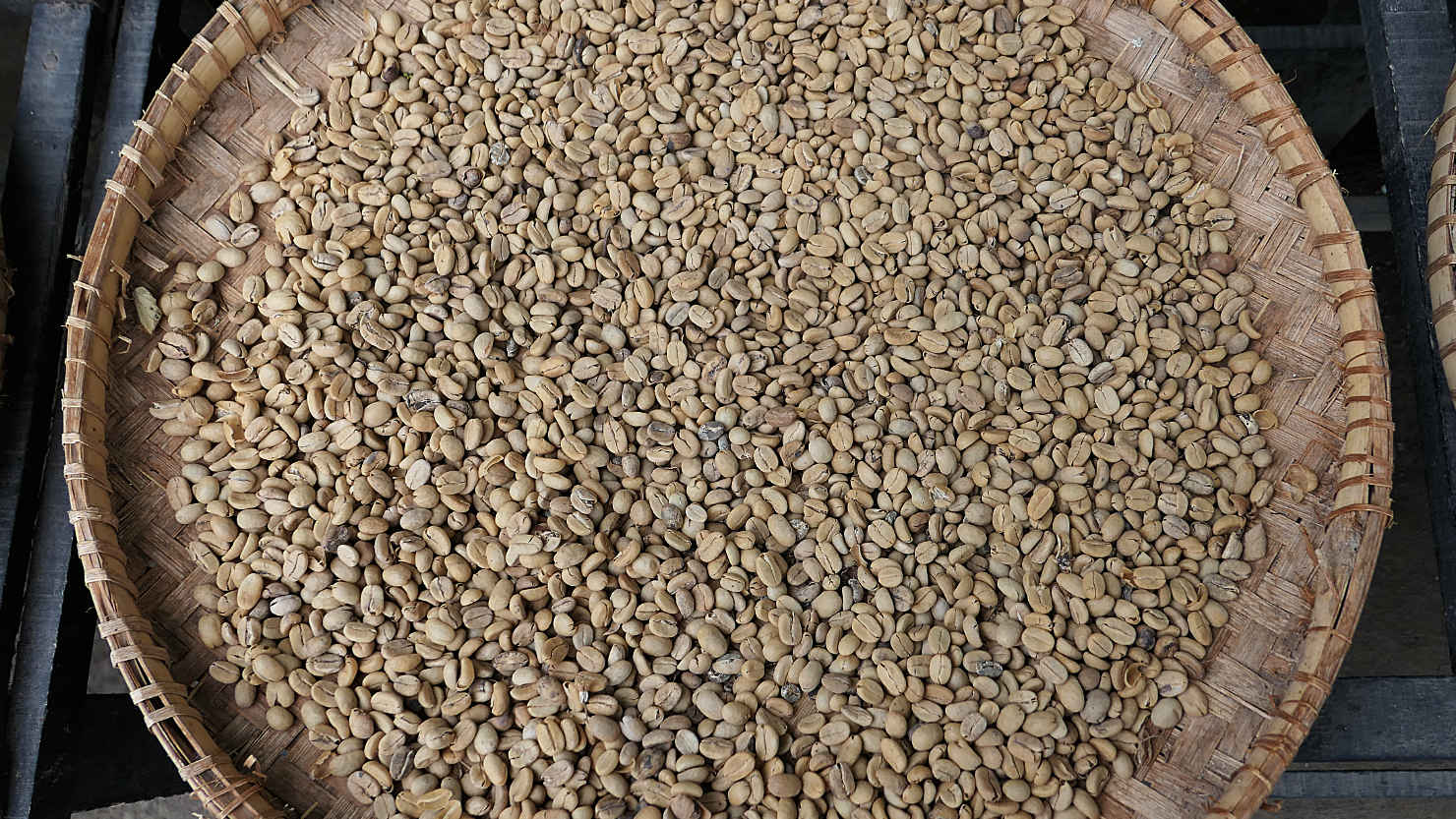
Washed coffee beans, ready for roasting.

Arabica and Robusta Kopi Luwak coffees. Both were good, but we both preferred the Robusta variety.
Two 9th Century Temples, Central Java
Video – Yogyakarta (Temples), Indonesia (Java)
Borobudor Temple
The 9th-century Borobudur temple is the world’s largest Buddhist temple and also known as one of the greatest Buddhist monuments in the world. The temple consists of nine stacked platforms, six square and three circular, topped by a central dome. The temple is decorated with 2,672 relief panels and 504 Buddha statues. The central dome is surrounded by 72 Buddha statues, each seated inside a bell-shaped stupa.

Borobudur Temple seen from a neighboring hill. The structure is amazing both from a distance and also close-up. Note the scale of the people walking around the different levels of the temple.

View of the Borobudur Temple from the entrance. All the temple’s stones were and still are hand stacked with no mortar. Again, note the size of the people compared to the overall size of the structure.

Wall relief details on the square levels of the temple. Our guide relayed several of the stories depicted by the reliefs.
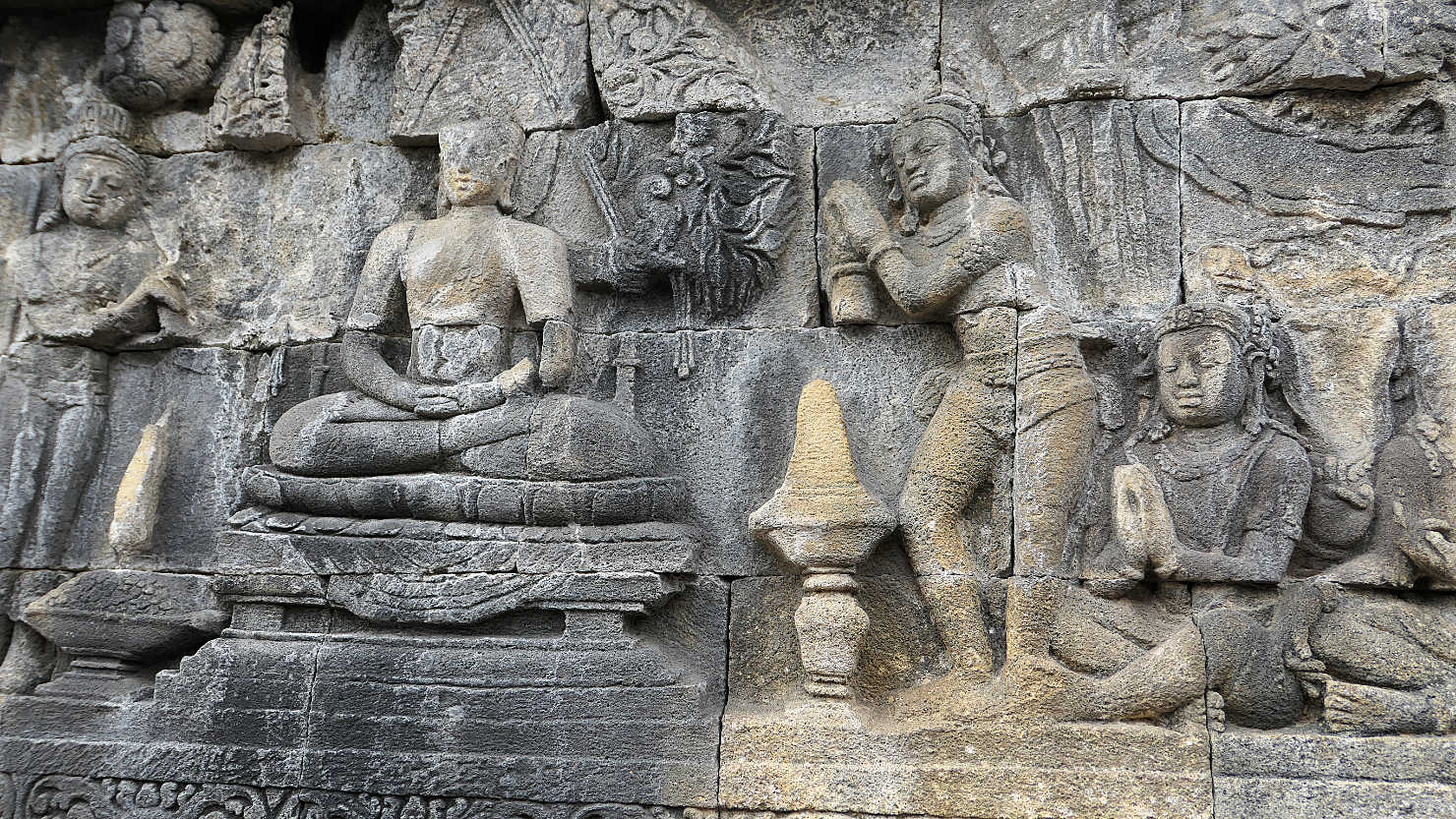
Closer view of the wall relief sculptures. The details were amazing up close.

Panorama from the upper level looking out over the temple’s bell shaped stupas.

Rick and Alisa among the upper level bell shaped stupas.

One of the buddhas as it sits inside each of the bell shaped stupas.
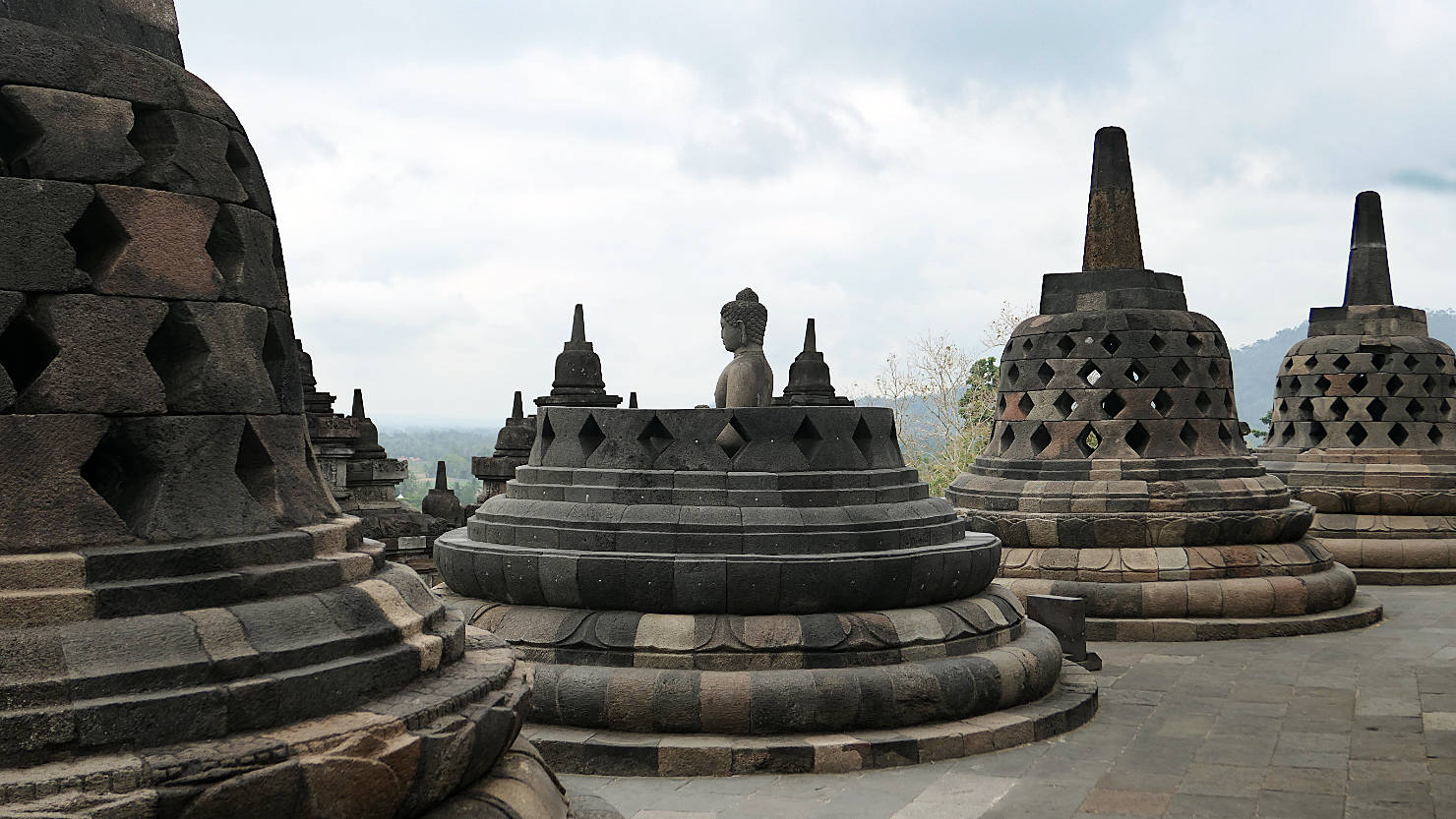
Another view showing how the buddhas sit inside each of the bell shaped stupas.
Prambanan Temple
The 9th-century Prambanan temple compound is the largest Hindu temple in Indonesia, and one of the biggest in Southeast Asia. The compound is characterized by its tall and pointed structures, typical of Hindu architecture, and by a towering 47 meter high (154 ft) central building which sits inside a large complex of smaller individual temples.
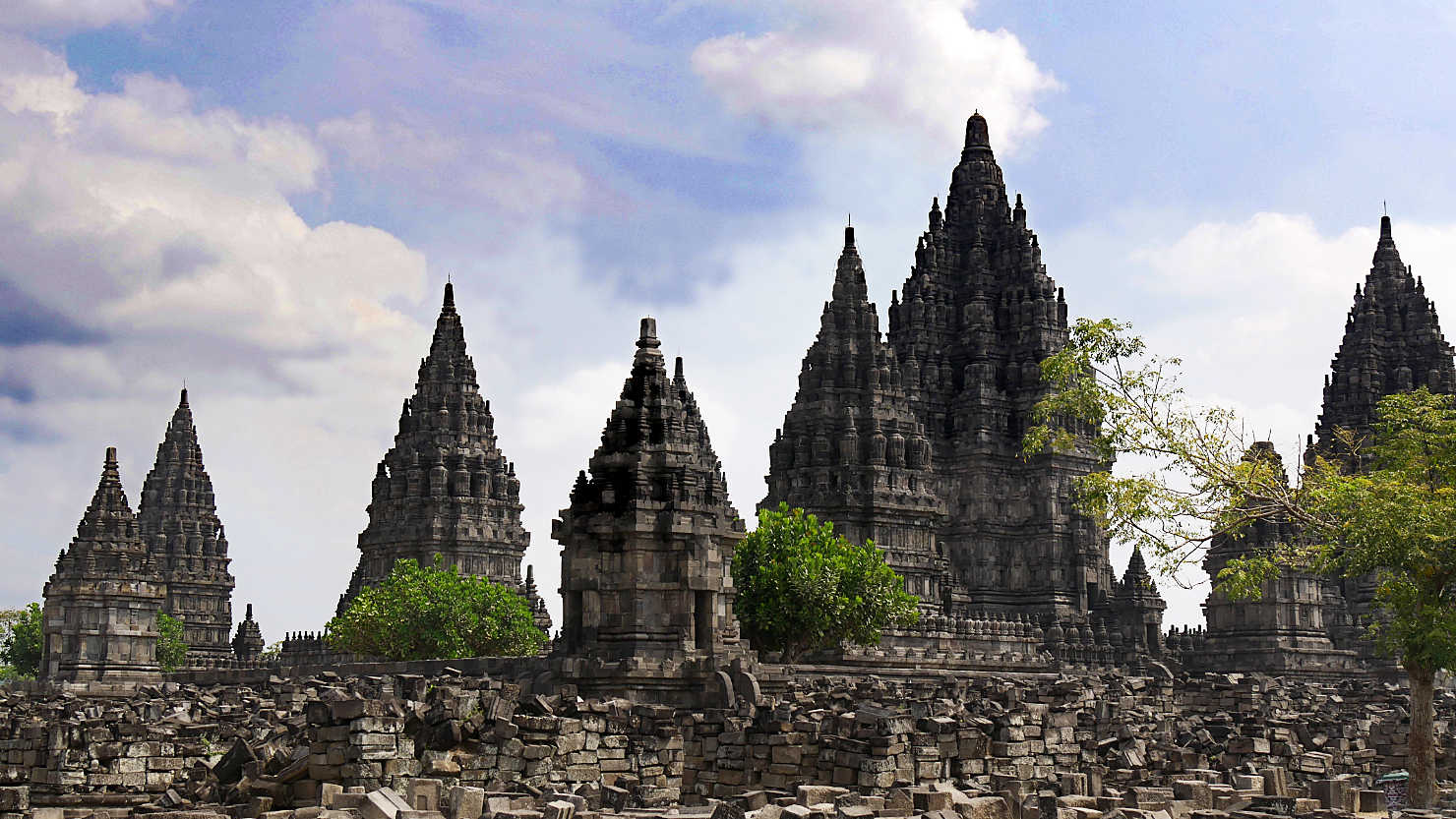
Prambanan Temple. It was difficult capturing the temple in it’s entirety as it’s very tall and spread out. The tallest central building is 154 ft high. It’s surrounded by several smaller temple structures. Note the debris and rubble piled around. This is damage from a 2006 earthquake. The restoration is an extremely slow and difficult process.

More distant view of the Prambanan Temple compound. Again look at all the debris and rubble piled around from the 2006 earthquake damage.

View looking up at the Shiva Temple, the largest central building at 154 ft high.
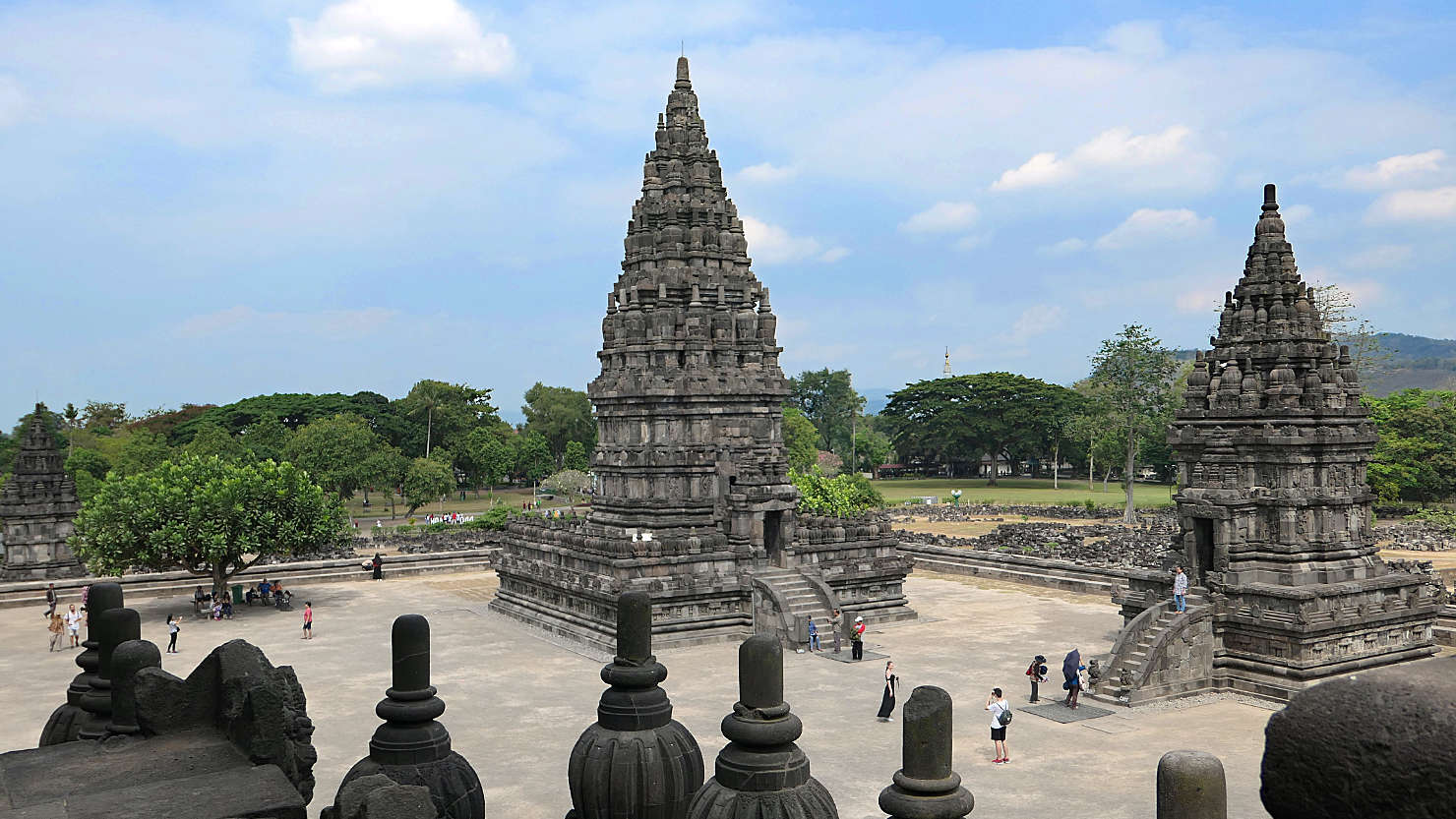
View looking out from the Shiva Temple to some of the smaller individual temples in the compound.
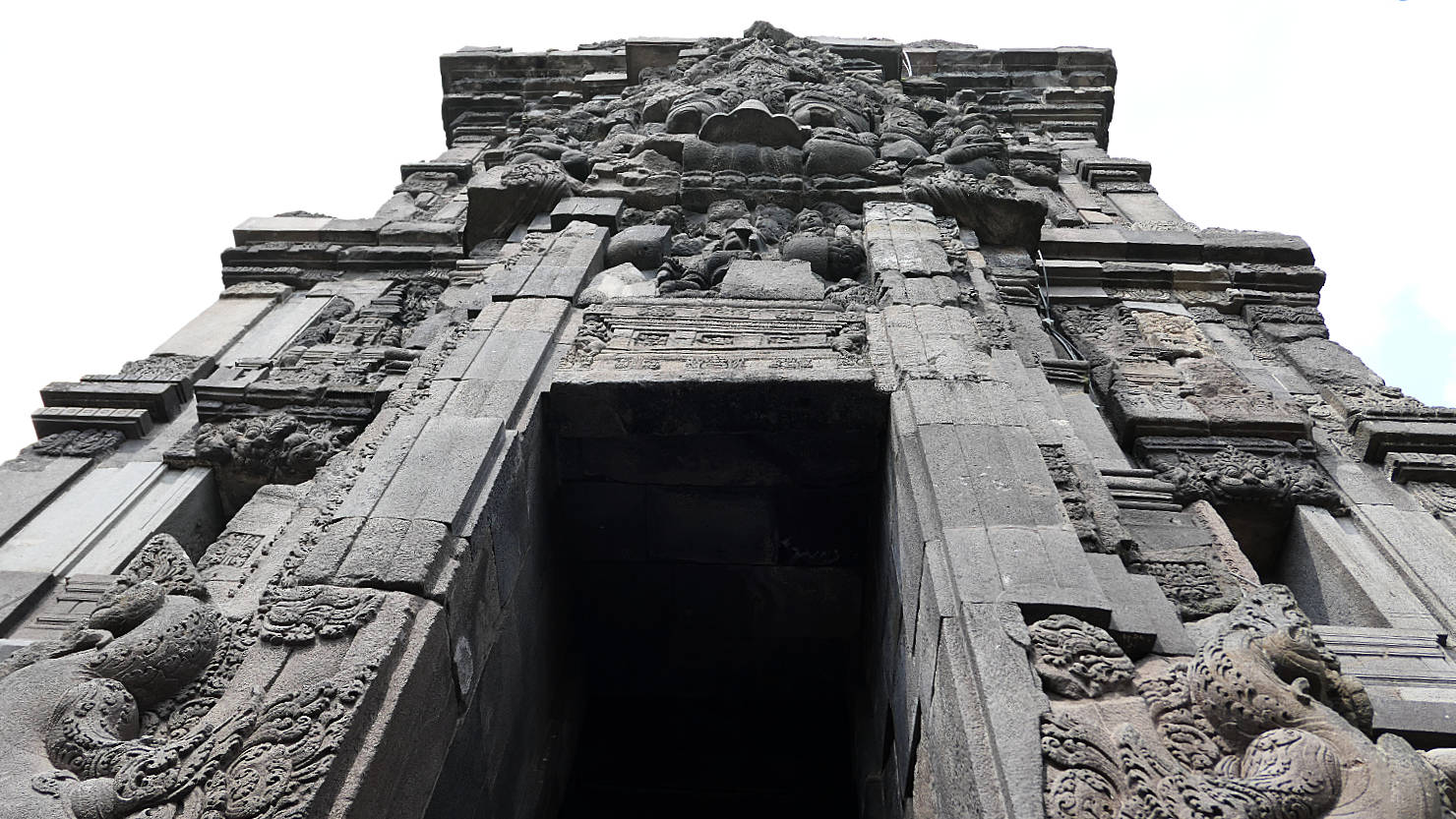
Doorway leading inside one of the individual temple rooms.

Brahma sculpture which sits inside one of the temple rooms. Each temple room has different sculptures.

Rick and Alisa with the Prambanan Temple compound in the distance.
Mt. Bromo, Eastern Java
Mt. Bromo, is an active volcano and part of the Tengger Massif, located in East Java, Indonesia. At 2,329 metres (7,641 ft) it’s not the highest peak of the Massif, but is the most well known. The three mountains which make up the Tengger Massif are: Mt. Bromo at 2,329 meters (7,641 ft), Mt. Semeru at 3,676 meters (12,060 ft), Mt. Batok at 2440 metrers (8,005 ft). Mt. Bromo sits in the middle of a plain called the “Sea of Sand”.
The typical and most popular way to see Bromo is from the nearby mountain village of Cemoro Lawang. Most people leave the village at 3:00 a.m. to watch the sunrise at one of 3 viewpoints on Mt. Penanjakan. You can hire a jeep or hike to the viewpoints. We opted for the hike, no guide was necessary. We left our guesthouse close to 3:30 a.m. and hiked steady for roughly an hour up a dark road to the first of the viewpoints. We were some of the first people to arrive as it was only 4:15 a.m. and over an hour before the expected sunrise. As time drew nearer to sunrise many others showed up. Luckily, most of the groups continued their way up to higher viewpoints which we’d heard weren’t as good and weren’t worth the additional effort.
We tried to stay warm while waiting patiently in the dark. The suspense was part of the fun…it was like waiting for an Imax movie to start on the big screen. We had just hiked up a dark road to a completely dark viewpoint and waited for over an hour without being able to see even a hint of Mt Bromo or it’s surrounding mountains. As the sun began to light the sky, the landscape in front of us began to take shape. We were slowly able to make out the Tengger Massif and specifically the Bromo Caldera. As the sun continued to rise the orange glow dramatically painted the entire area. All of the active volcanoes came to life right before our eyes making for an absolutely spectacular sight.
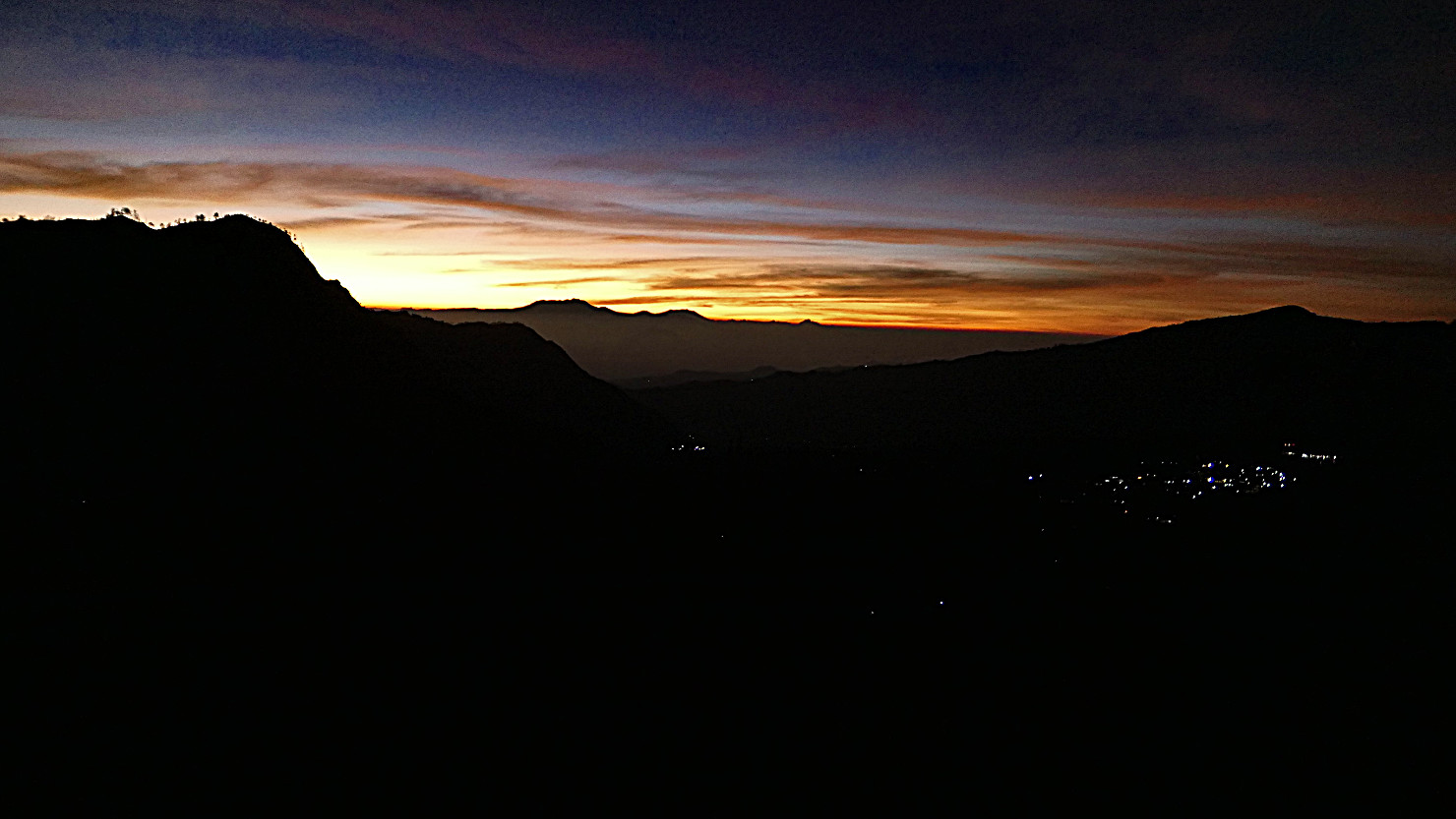
The lights of the Cemoro Lawang village in the distance as the sun is barely starting to light the sky. The village is also where we started our early morning hike from.
Video – Mt Bromo, Indonesia (Java)
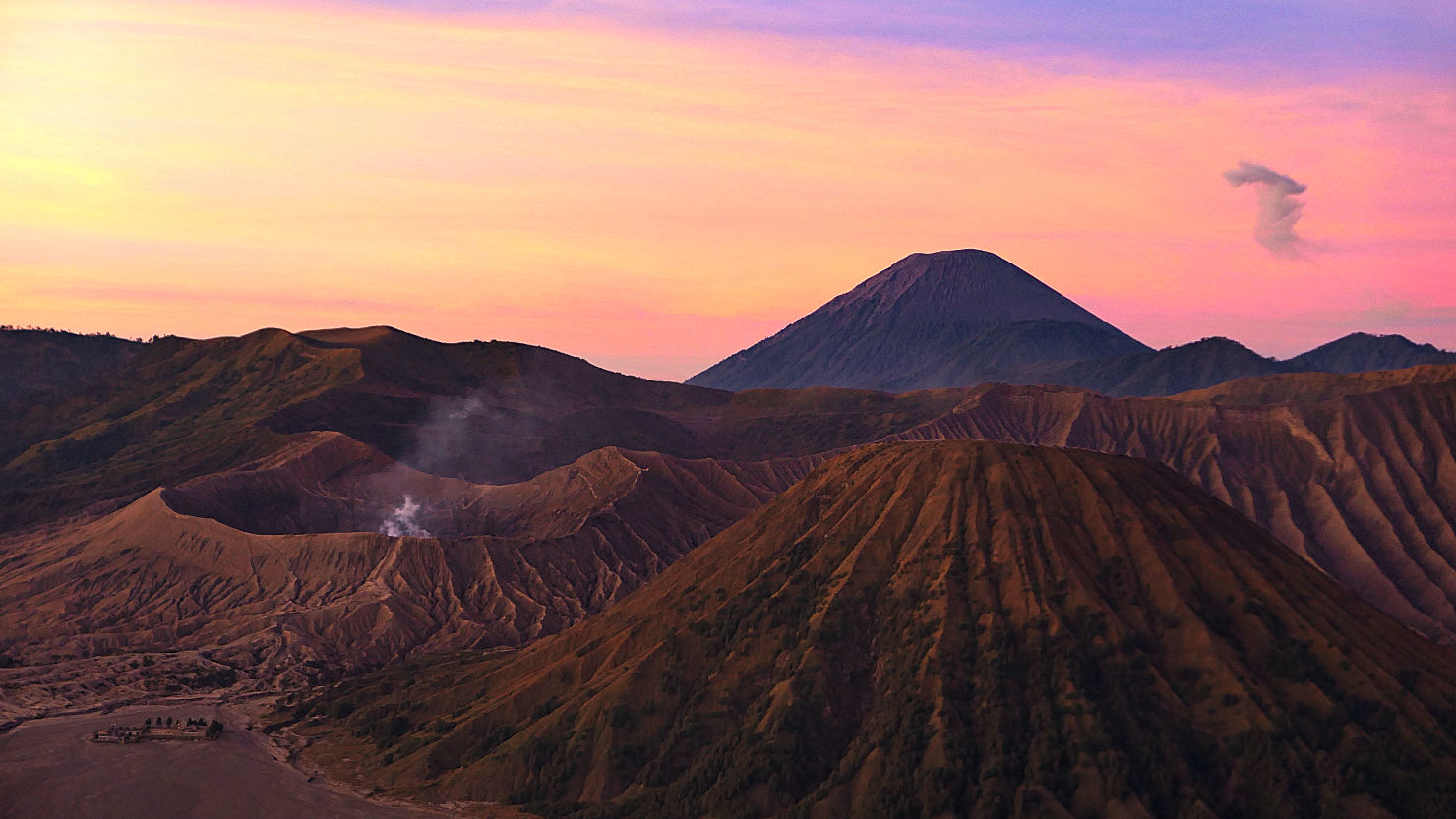
The Tengger Massif as the sun begins to light up and color the horizon.

Our first glimpse of the active Bromo Caldera. You can see the stairway leading up to the rim at center right below the steam.
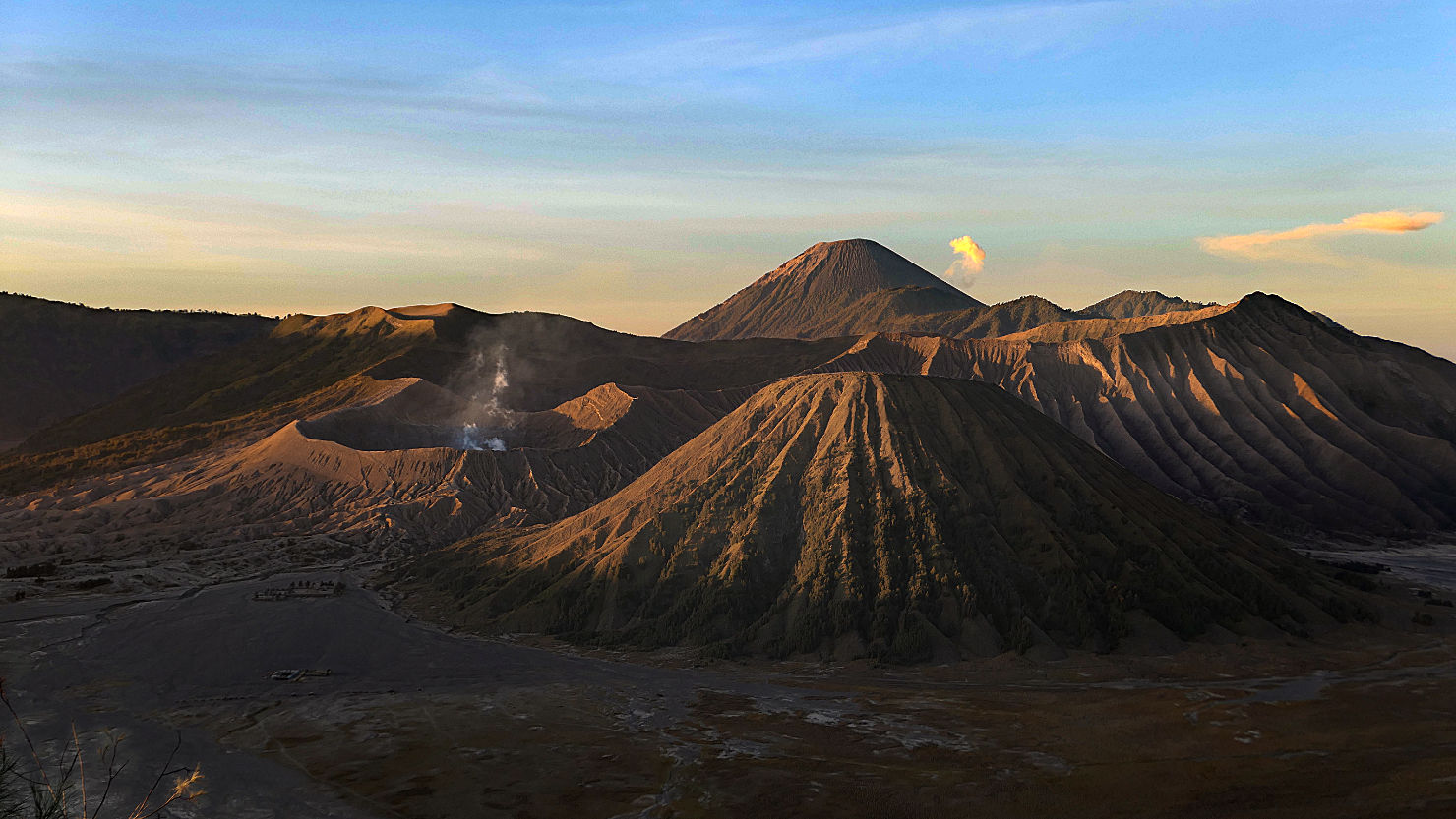
The Tengger Massif as the sun hits the landscape. The Bromo Caldera is on the left with the steam.
Locals and Photos with Us…
Extremely friendly locals asking to have their photo taken with us has become quite the norm since starting our journey in Indonesia. The locals are always very genuine when confronting and asking if they could take a photo with us. At first, it seemed strange, but now we aren’t even phased by it – we simply say “sure” which immediately puts smiles on their faces. This is common practice here and they truly want a photo with westerners. It happens so often, we now try to have a photo taken using our camera so we can document some of these encounters. Another funny thing is they always act like we are celebrities which makes us laugh every time. And, after each encounter, we always joke that this is what it must feel like to be famous… BTW – we had several other locals who asked for and took photos with us on our day at Bromo.
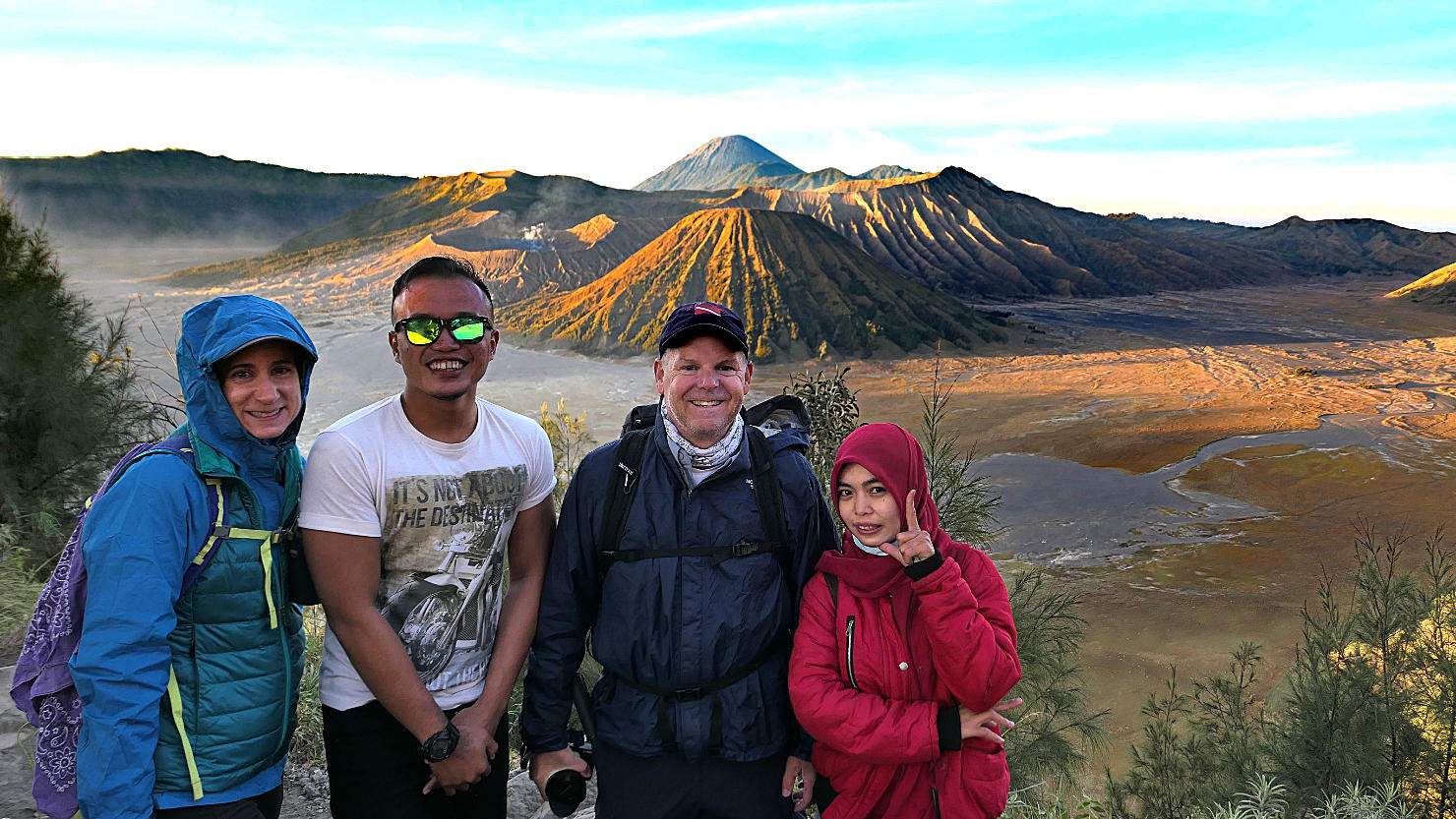
Young couple from Jakarta who approached us and were very eager for to have their photo taken with us.

All the friends of the young Jakarta couple wanted to join in as well.

Panorama view of the Tengger Massif and the Sea of Sand surrounding it from our sunrise viewpoint.
Following the sunrise, we hiked an hour back to our guesthouse in the village for breakfast before walking across the Sea of Sand to the Mt. Bromo caldera to witness the volcano up close and personal.
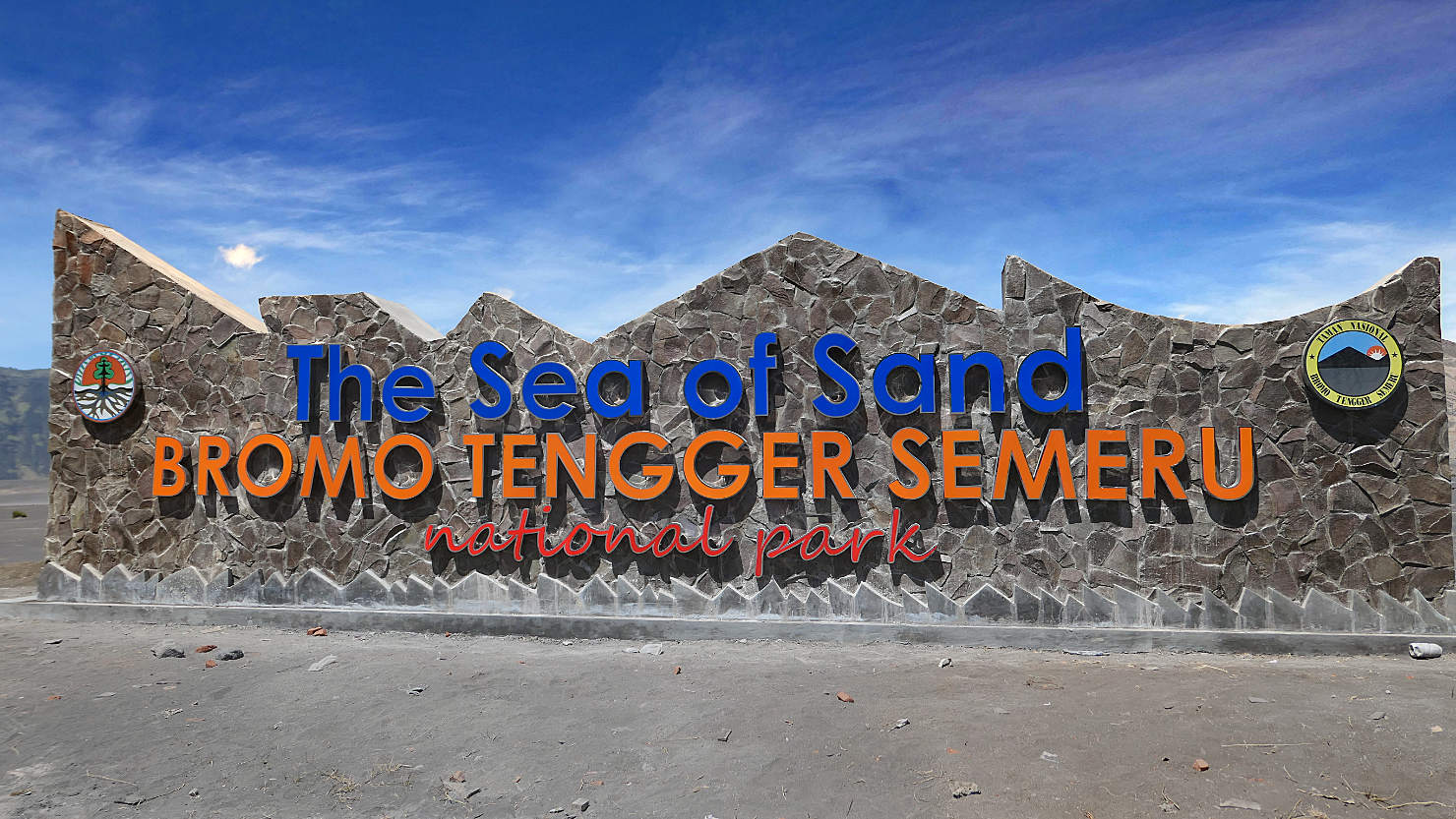
The entrance to the Sea of Sand which is exactly what it sounds like…A vast area of sand crossing from the village to the Tengger Massif.
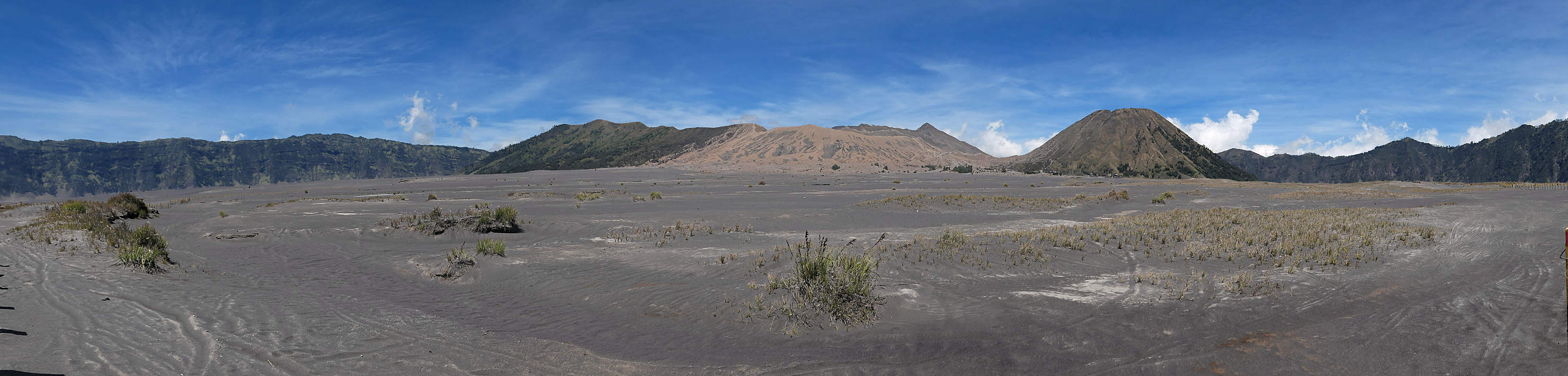
Panorama of the Sea of Sand leading to the Bromo caldera. This is a wide open area full of sand and many people use motorcycles, jeeps, and even horses to cross. We opted to walk the roughly hour long distance from the village to the base of the caldera.

Getting close to the base of Bromo. The size of the caldera was unbelievable. From here, you can see the staircase leading to the top with the tiny people standing on the rim. You could also hear the volcanic activity coming from the center of the caldera…it sounded like a jet engine!

Some of the horses who carried people up to the base of the staircase leading to the rim.

Rick getting ready to head up the stairs to see the action inside Bromo’s caldera.
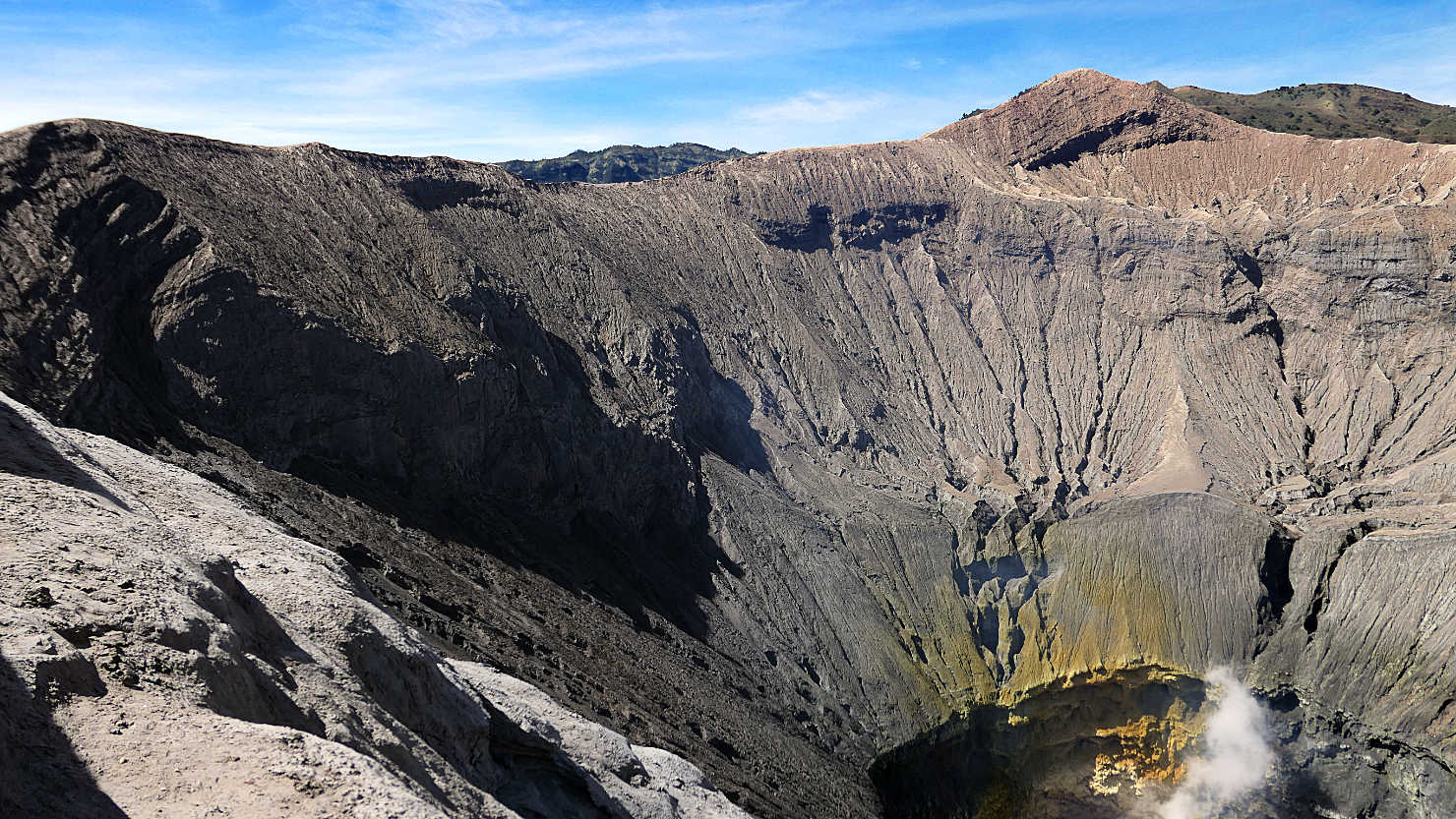
Standing on the rim looking into the caldera.

View of the caldera and volcanic activity.
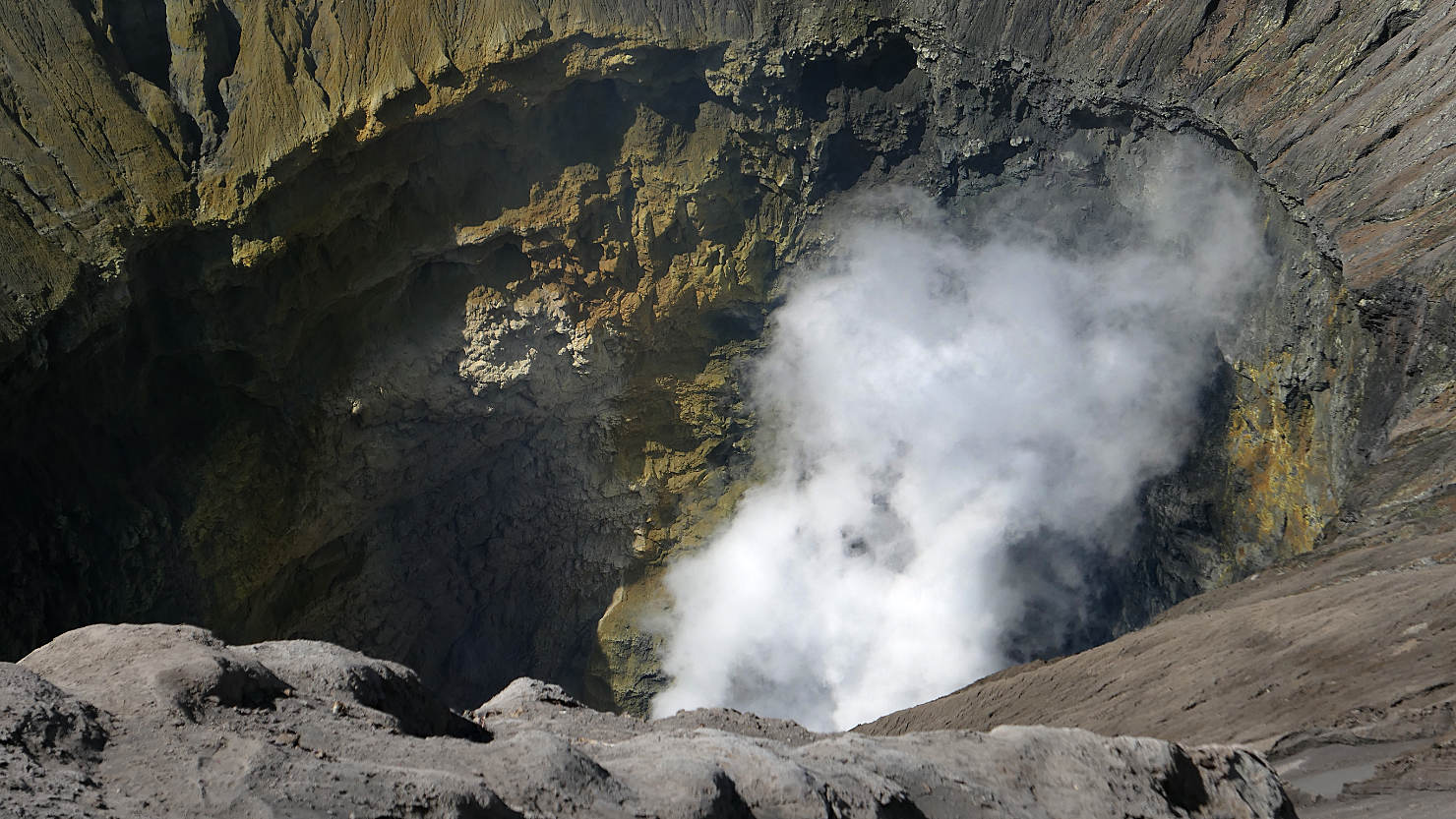
Close-up view looking into Bromo and down into the center of the earth.

Rick and Alisa standing on the rim looking into the Bromo caldera. Being up here was very unnerving…the jet engine sound coming from the volcano was deafening. The “path” along the rim was barely a few feet wide in spots with a very short (mid-calf height) and partially broken railing on the caldera side with no railing on the other side. With all of the people sitting and standing in the path, it was alls we could do to simply walk around up here to get a look inside and snap a few photos. To be able to stand on an active volcano rim and look straight into the earth was very exciting, unreal, and also very scary!!!
Mt Ijen, Central Java
The Ijen volcano in East Java is famous for its “Blue Fire”. The blue fire is created from the combustion of sulphuric gases. Those gases emerge from the cracks in the volcano at high pressure and temperature. When they come into contact with air, they ignite, sending blue flames up tp 5 meters (16 ft.) high. Ijen is also famous for its 1 km wide turquoise colored hydrochloric acid filled crater lake. The lake is also the worlds largest known such body of water.
To see Ijen’s blue fire, we departed our hotel at 12:30 a.m. Our driver dropped us at the Ijen parking lot at 1:45 a.m. At 2:00 a.m, we, along with our guide, departed the parking lot with our headlamps on to start our dark trek up the mountain trail. The climb was all uphill and very steep for most of the hour and 10 minutes it took to get to the crater rim. At times, it was necessary to wear a gas mask when the wind changed direction engulfing us in a thick sulphur cloud.

Rick and Charlie, our guide, standing on Mt Ijen’s rim at roughly 3 a.m. From here we hiked 20 minutes in the dark down a steep narrow trail to the crater floor. Our guide was fantastic. He’d been a miner for 8 years and knew every detail of the trail even in the dark. Because he’d worked as a miner he also knew the best places to view Ijen’s blue fire and it’s acid lake.

3 a.m. view from the crater rim of Ijen’s acid lake and it’s sulphur cloud by the light of the full moon.
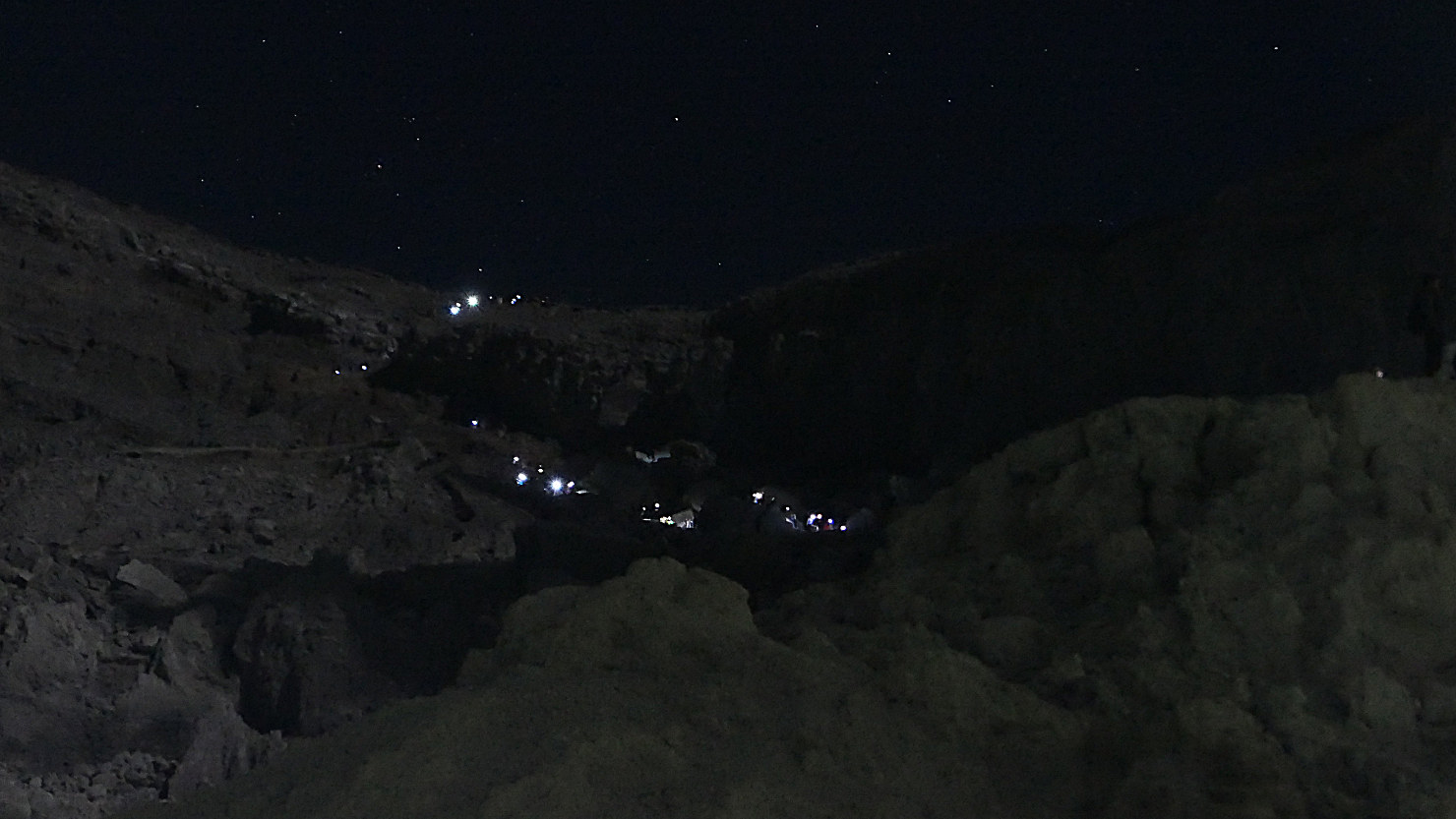
Other hiker’s headlamps as they make their way down the trail to the crater floor.
Video – Mt Ijen, Indonesia (Java)

Our first glimpse of Ijen’s blue fire. We had a great spot to hang out for the best view of the blue fire. Some of the flames were enormous as they ignited. You can see the scale compared to the people in the bottom of the photo.

The flames were electric blue in color and very mesmerizing. Sitting watching the blue flames ignite and change was very surreal. Luckily, most of our time here the wind direction kept the sulphur smoke blowing away from us. Again note the size of the people in the bottom left of the photo.
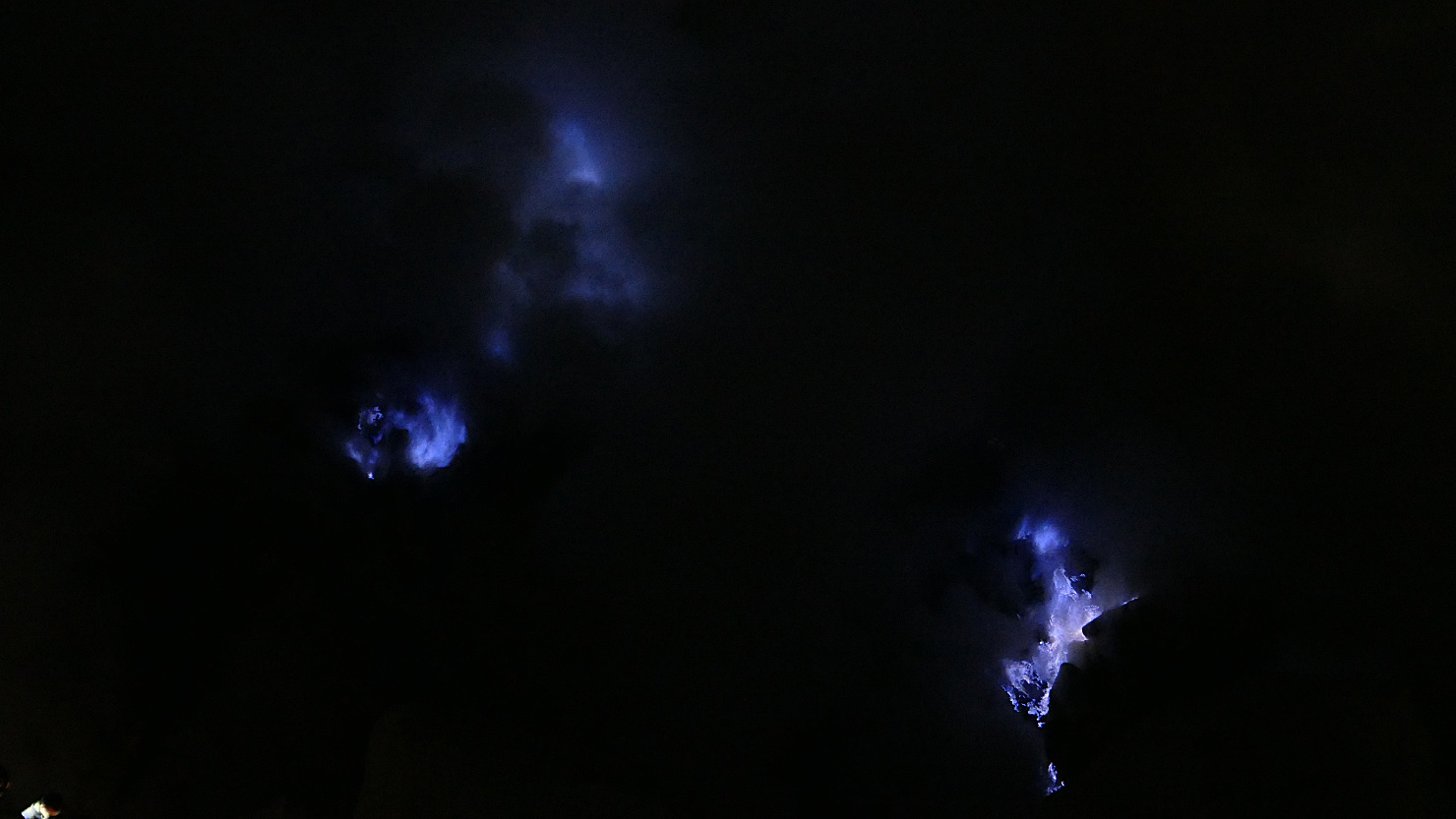
Multiple blue flames glowing along the caldera wall.
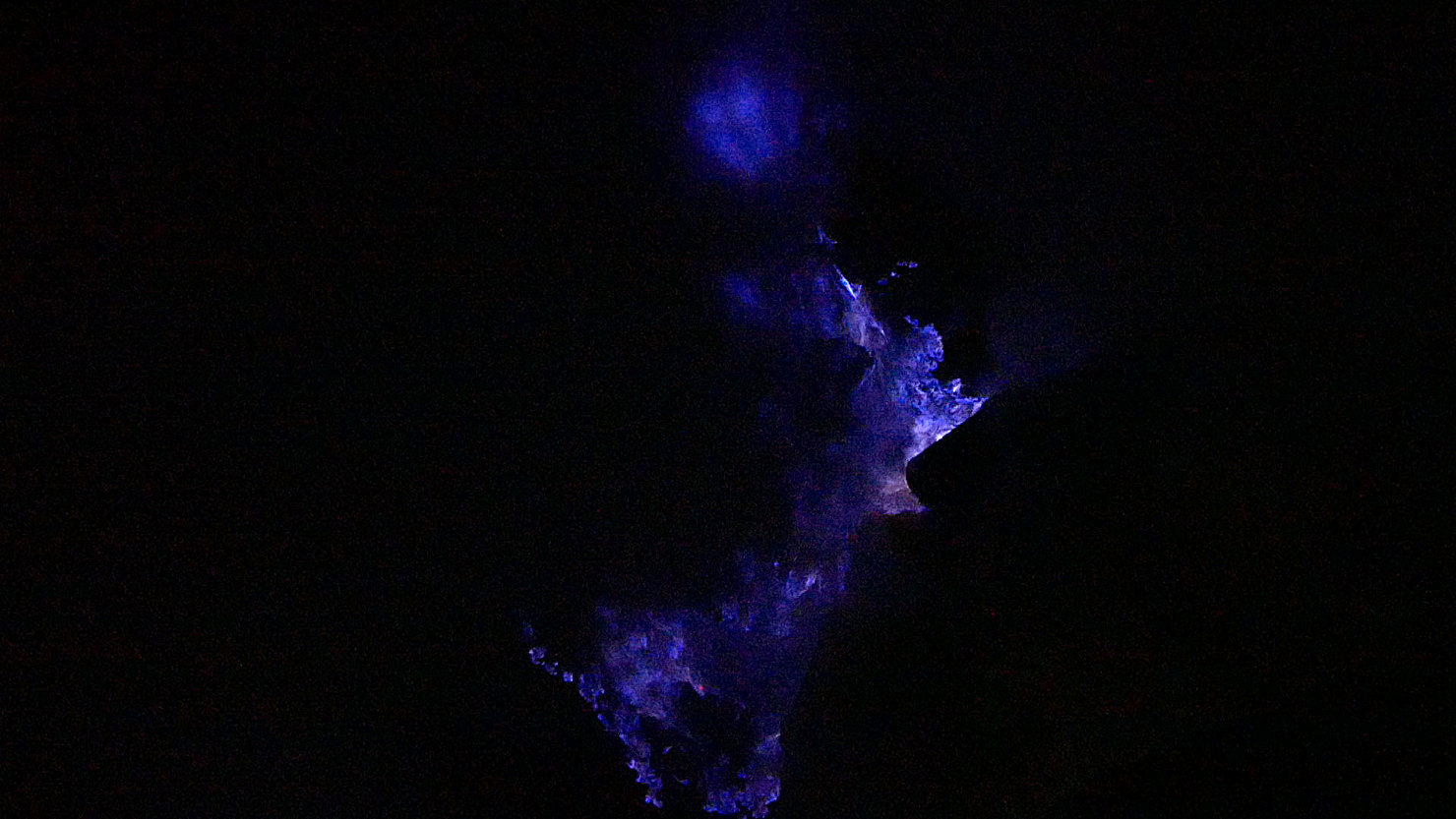
Close-up view of the electric blue fire.
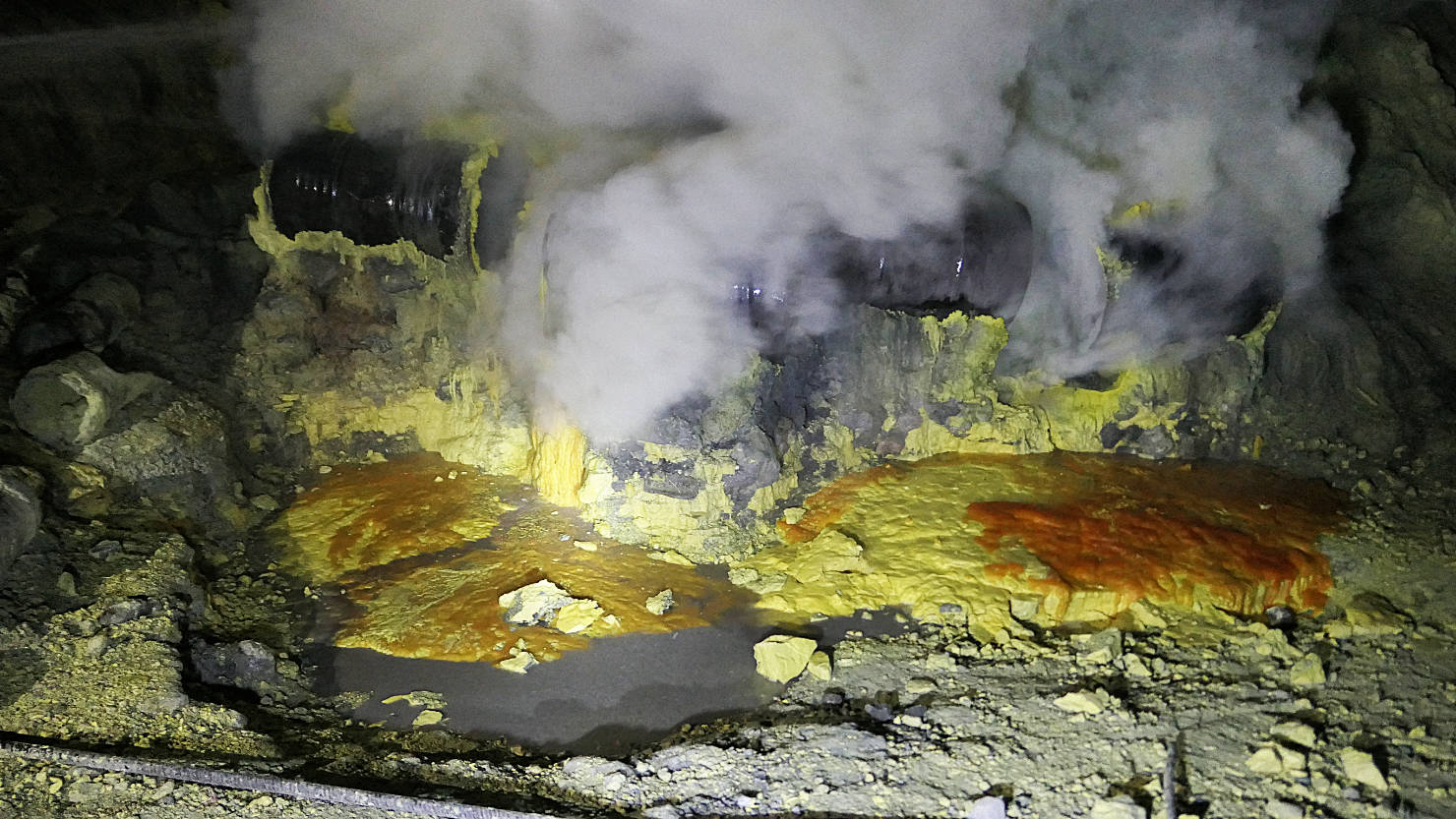
Sulphur vent pipes where the condensed liquid sulphur drips into areas where it then solidifies into sulphur mats.
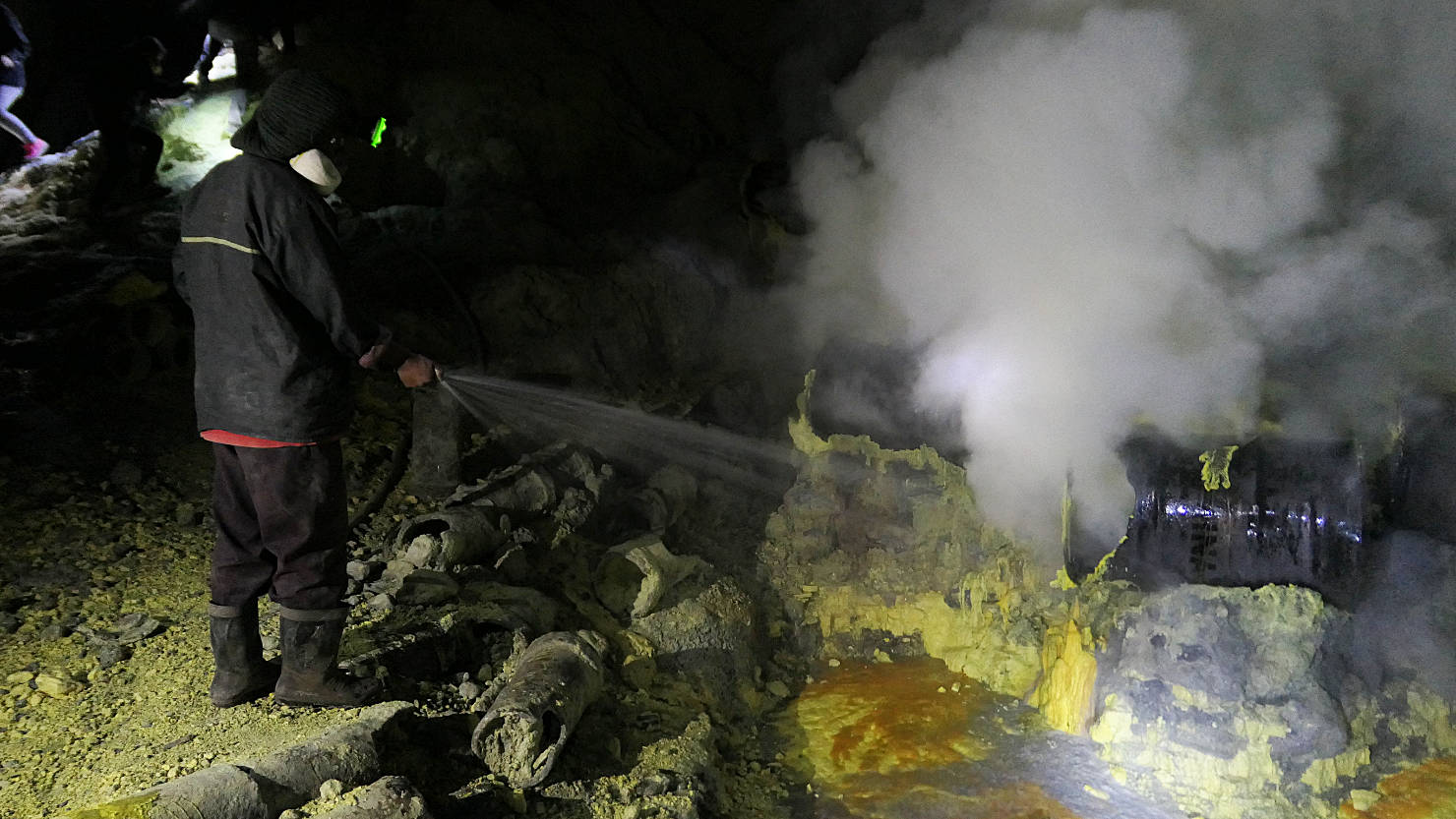
One of the sulphur miners spraying the sulphur vents to help the cooling process.

Miner breaking up the freshly solidified sulphur mats into pieces ready for transport.
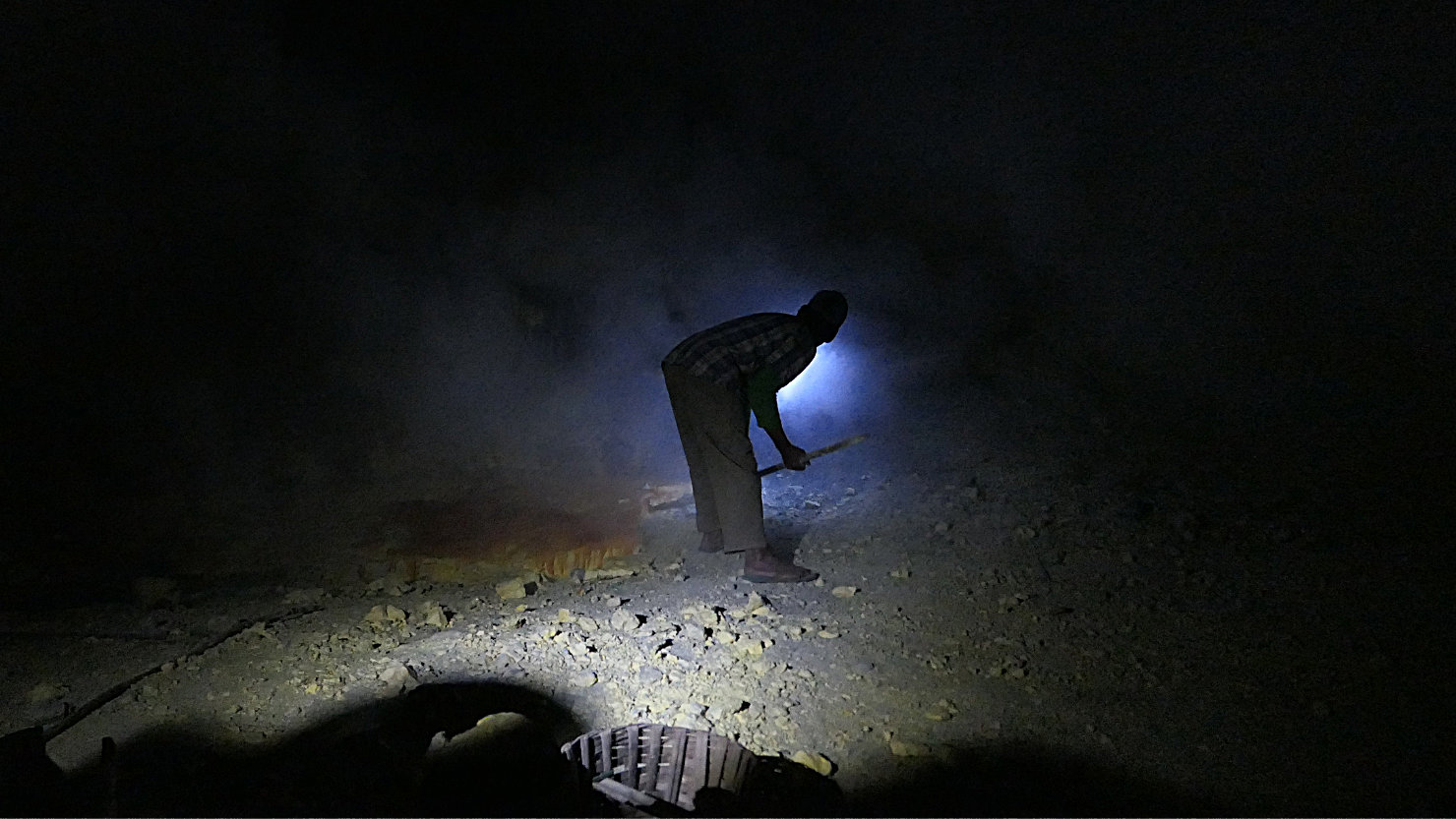
Closer view of the miner breaking the sulphur mats into pieces. Sulphur mining is very labor intensive work with many health related risks.
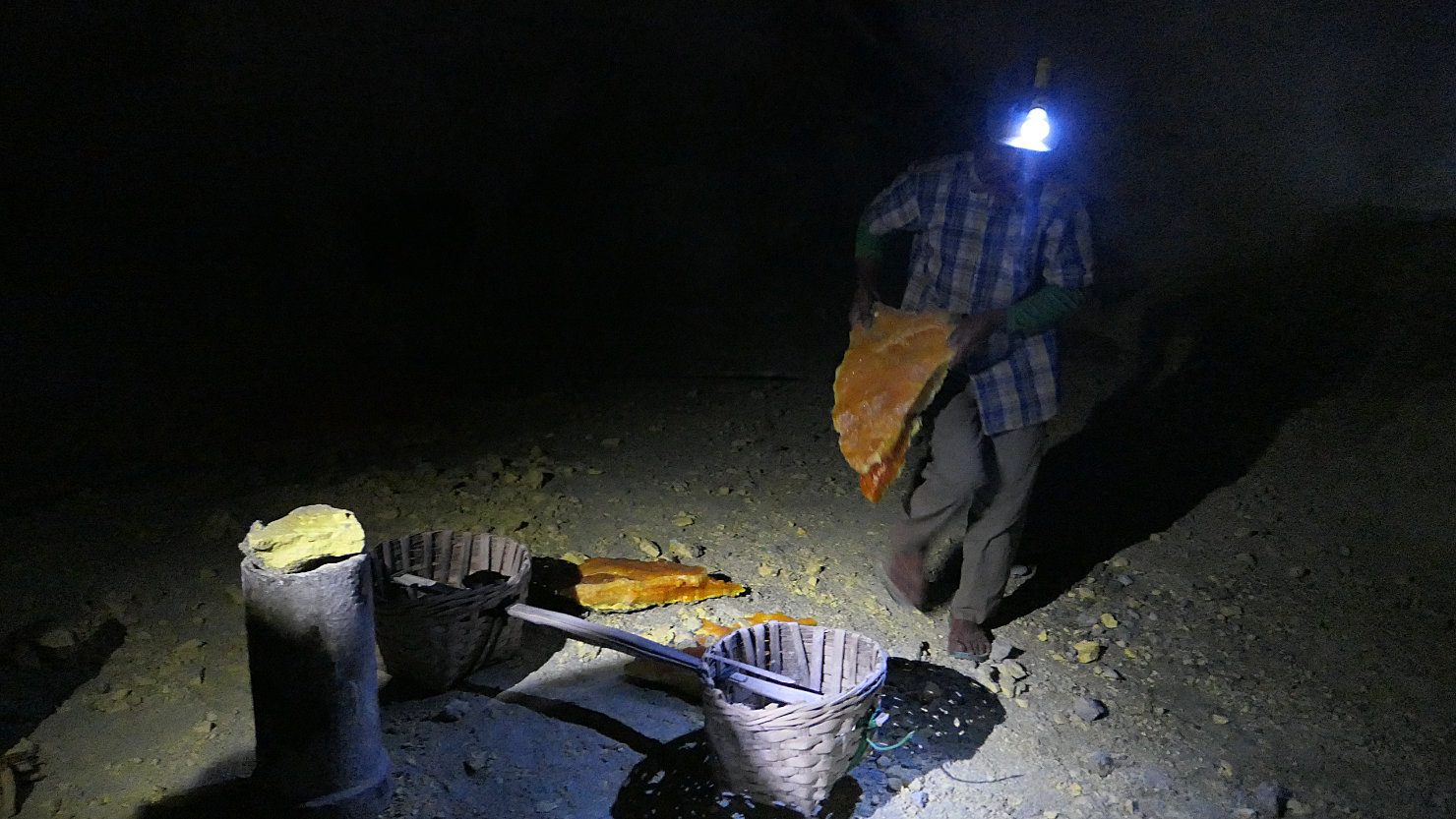
Miner carrying the sulphur pieces to load into the baskets. Note the miner is wearing flip flops.
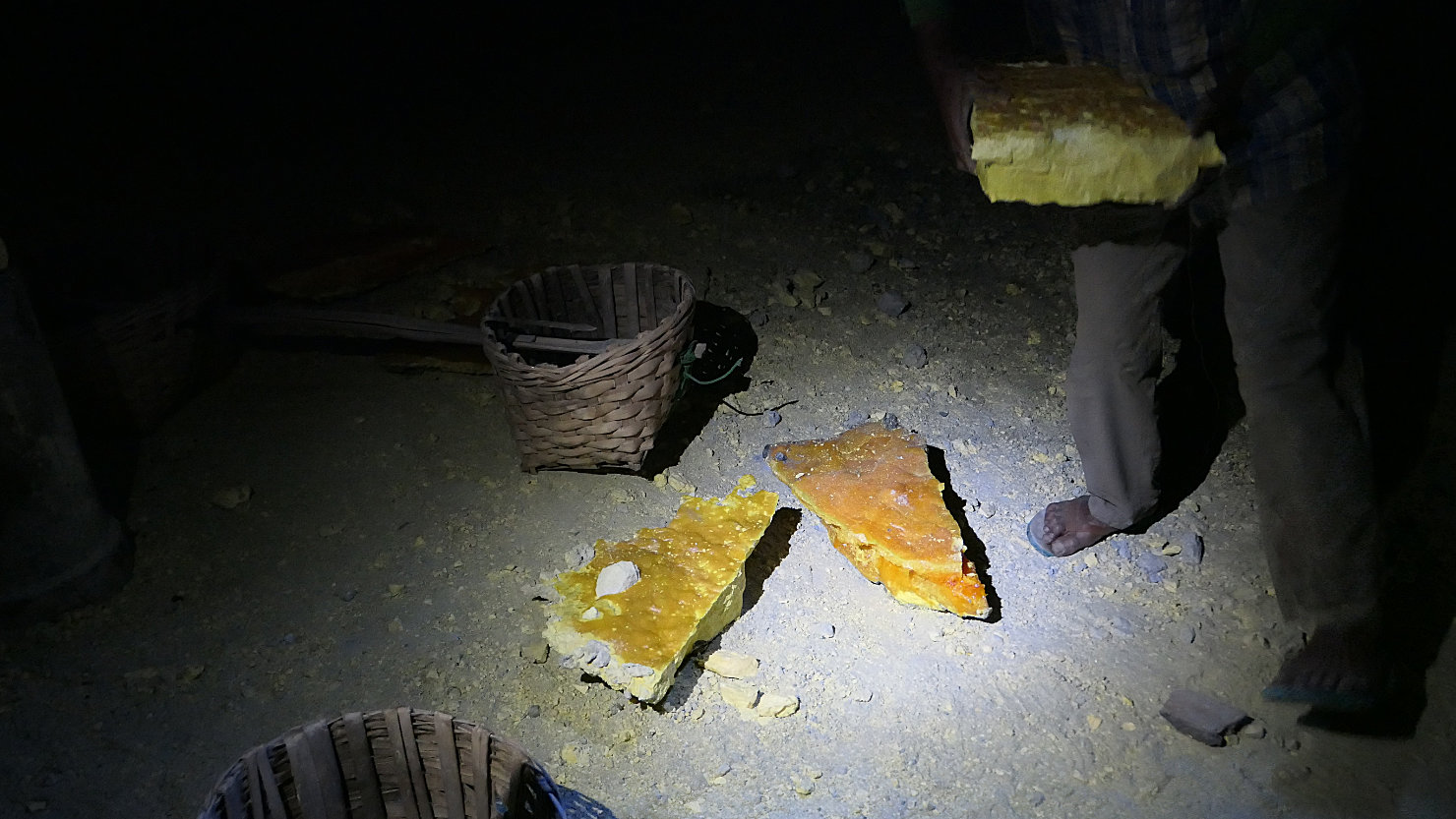
Sulphur pieces cooling prior to being loaded into baskets and carried off the mountain by the miners. These fully loaded baskets (weigh min 60 kg and max 90 kg) are carried across the miner’s shoulders.
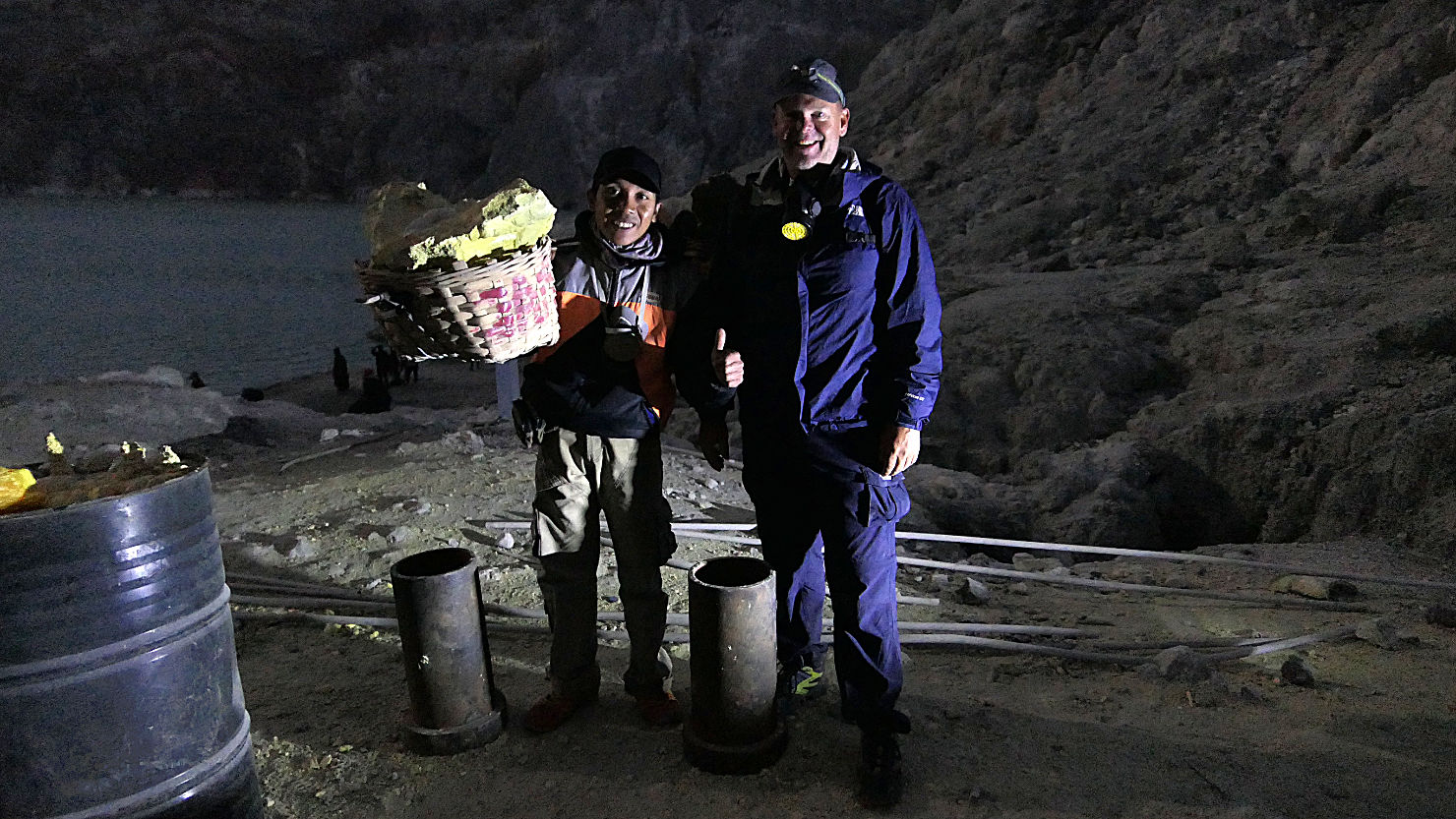
Charlie (our guide was a miner for 8 years) picked up a fully loaded basket like it was nothing and asked for a photo with Rick. As Charlie picked up the basket, he mentioned it being light at only 60 kg (132 lbs) which we’re pretty sure is more than his own body weight.
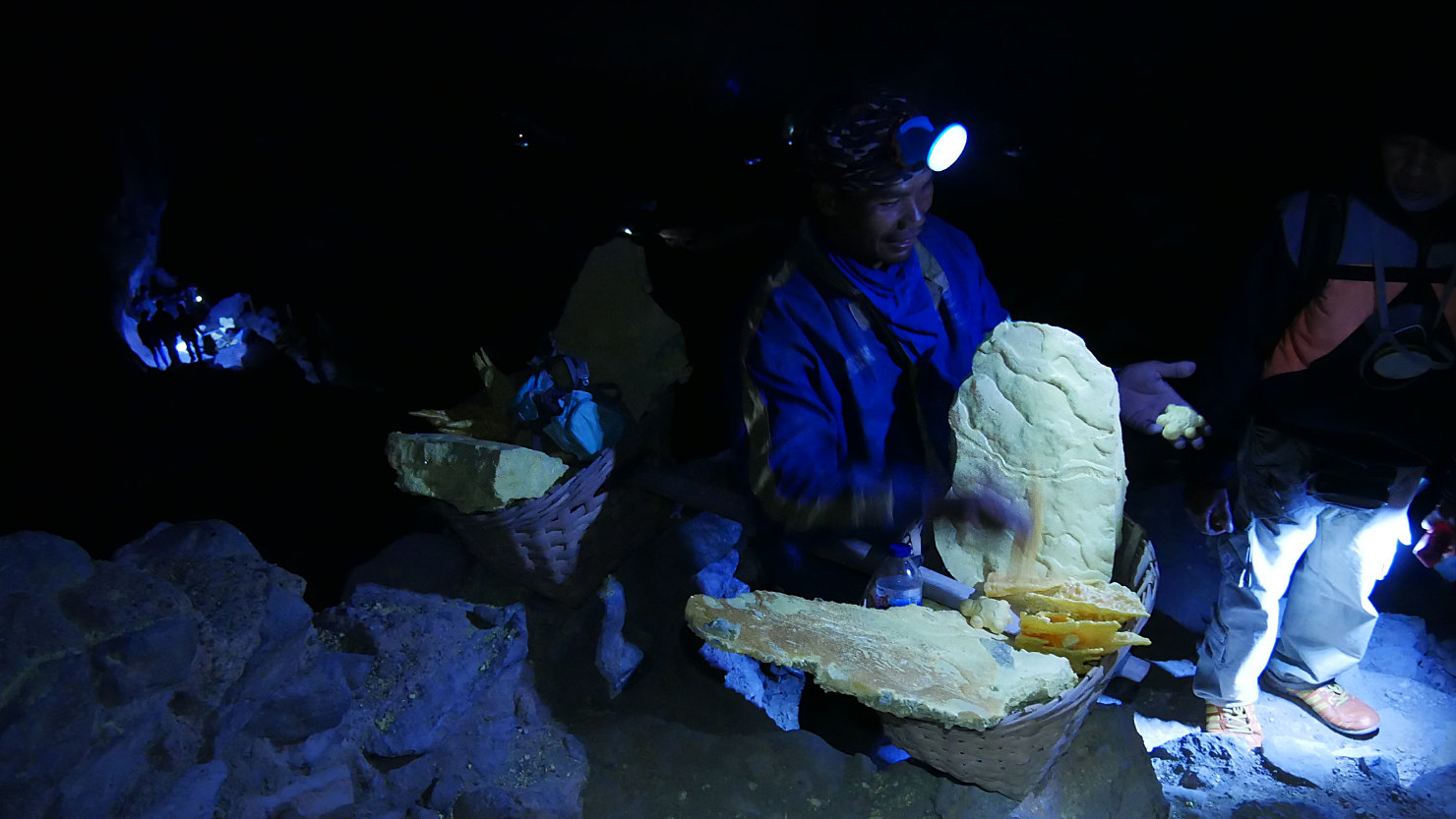
One of the miners selling carved and natural sulphur sculptures to tourists to help supplement his income. The labor intensive mining work is paid by the load carried off the mountain and is considered a good wage at roughly $5.50-$8.30 USD per day.

The sulphur vents at daylight.
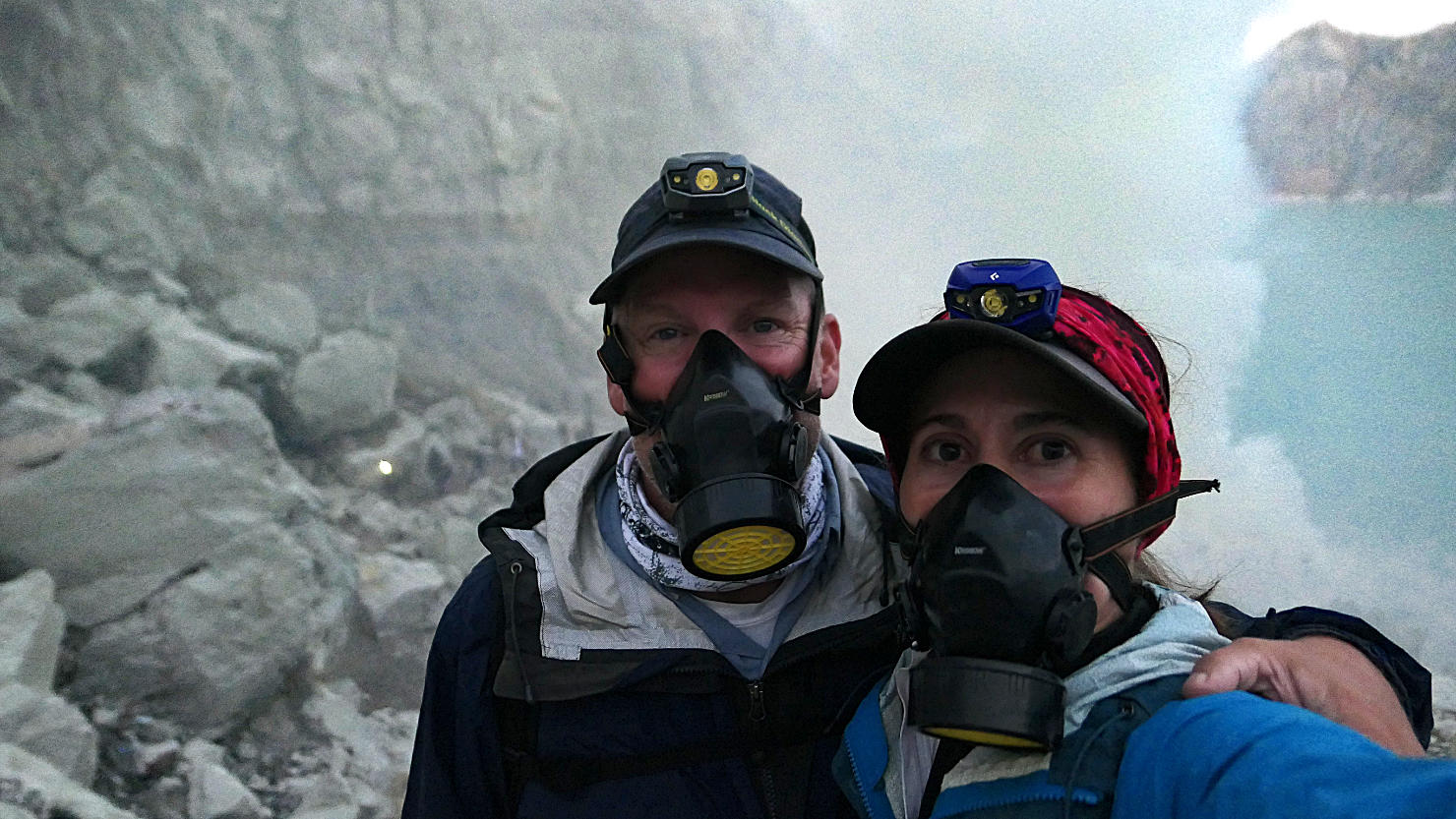
Rick and Alisa with their gas masks on to aid their breathing in the surrounding sulphur cloud.

Rick and Alisa beginning the trek back up to the rim.
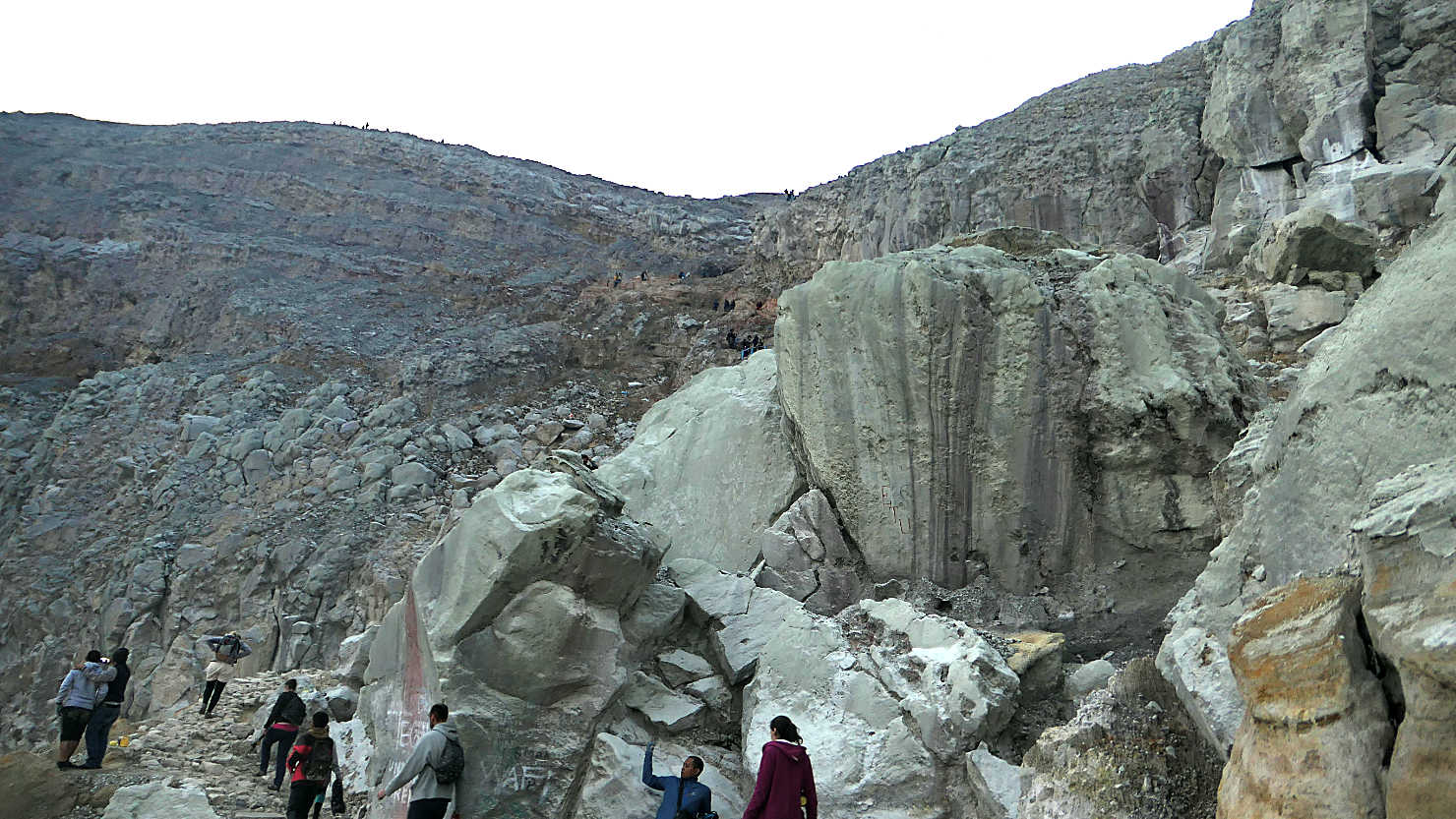
Looking up at the caldera rim from the trail below.
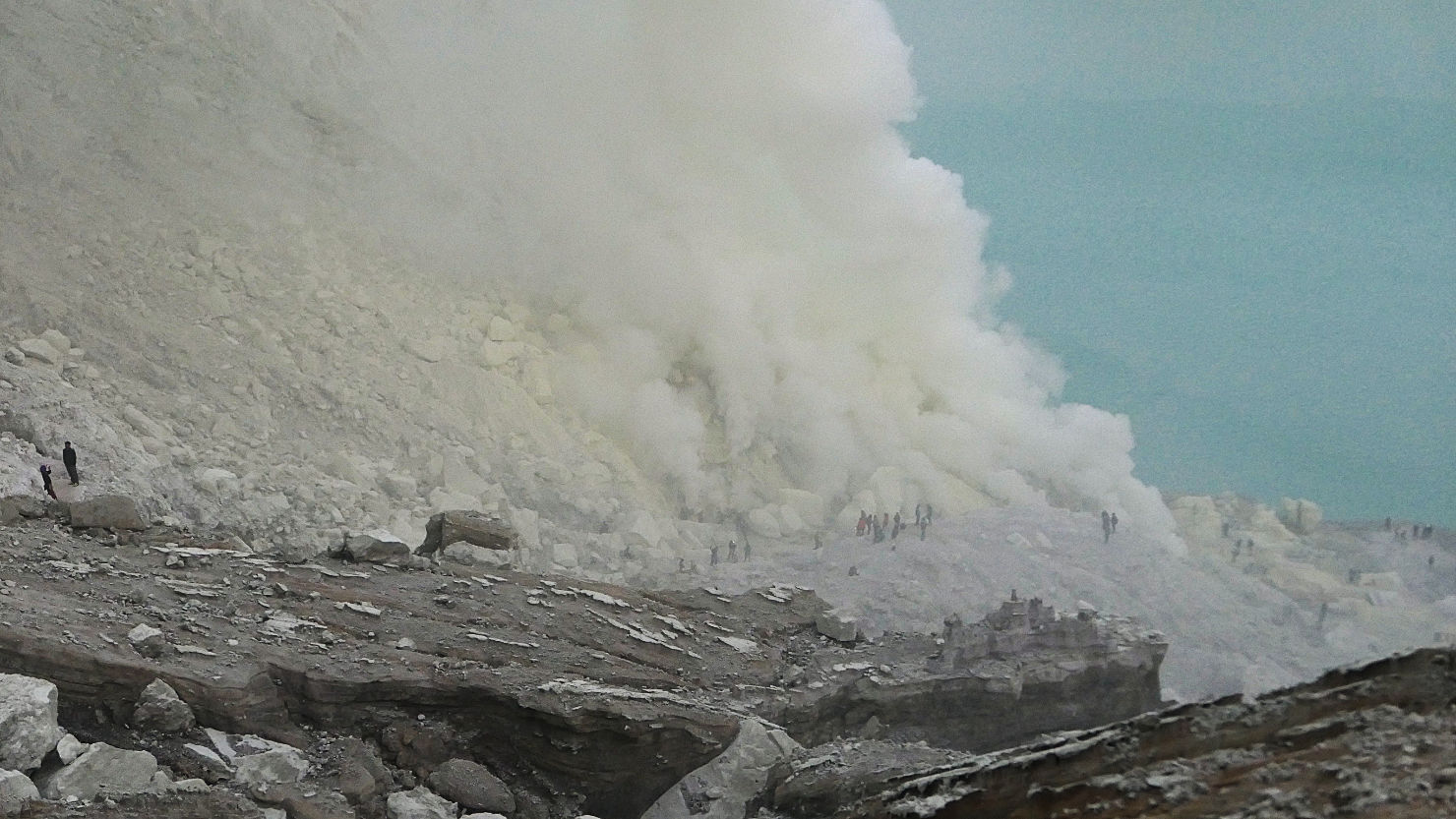
The sulphur vents and mining operation seen from a distance. Along the crater wall behind the sulphur cloud is where the blue fire ignites, but the blue flames can only be seen in the dark.

Panorama from back on the crater rim as the sun continues to rise.
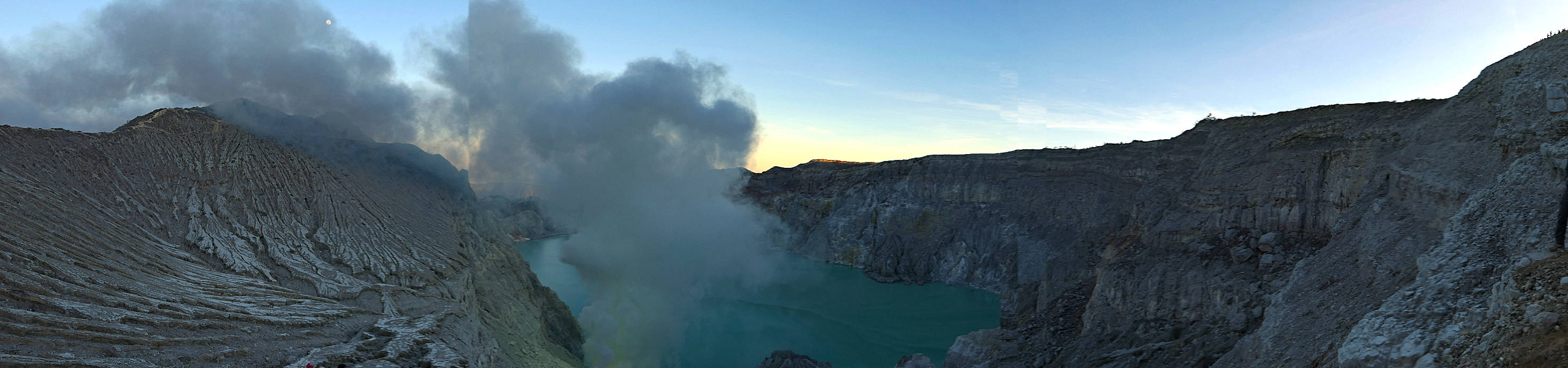
Panorama looking into the Ijen crater.

Ijen’s acid lake and sulphur mining area at daylight seen from the crater rim.
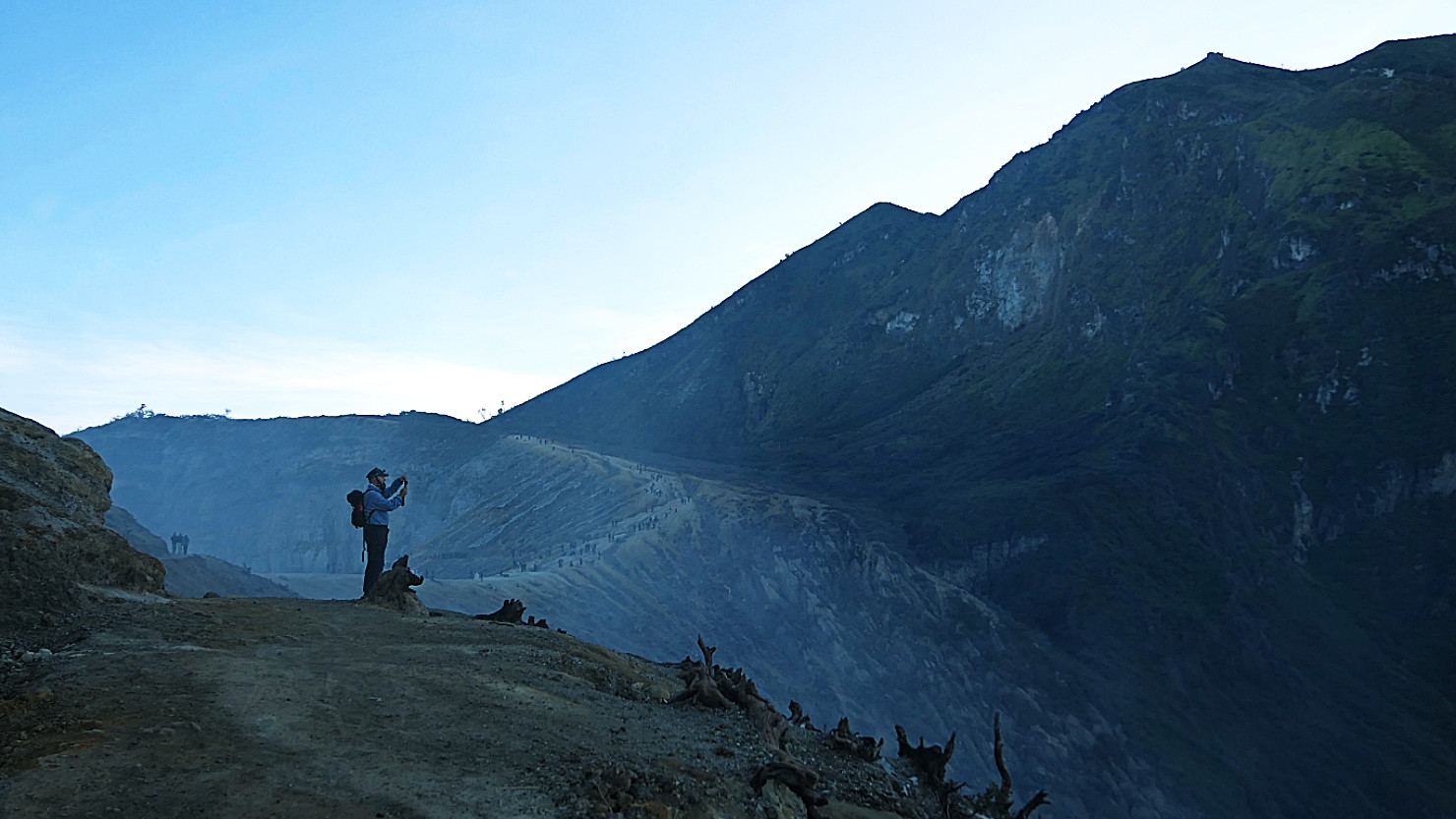
Rick taking video as we head back down the trail to the parking lot.
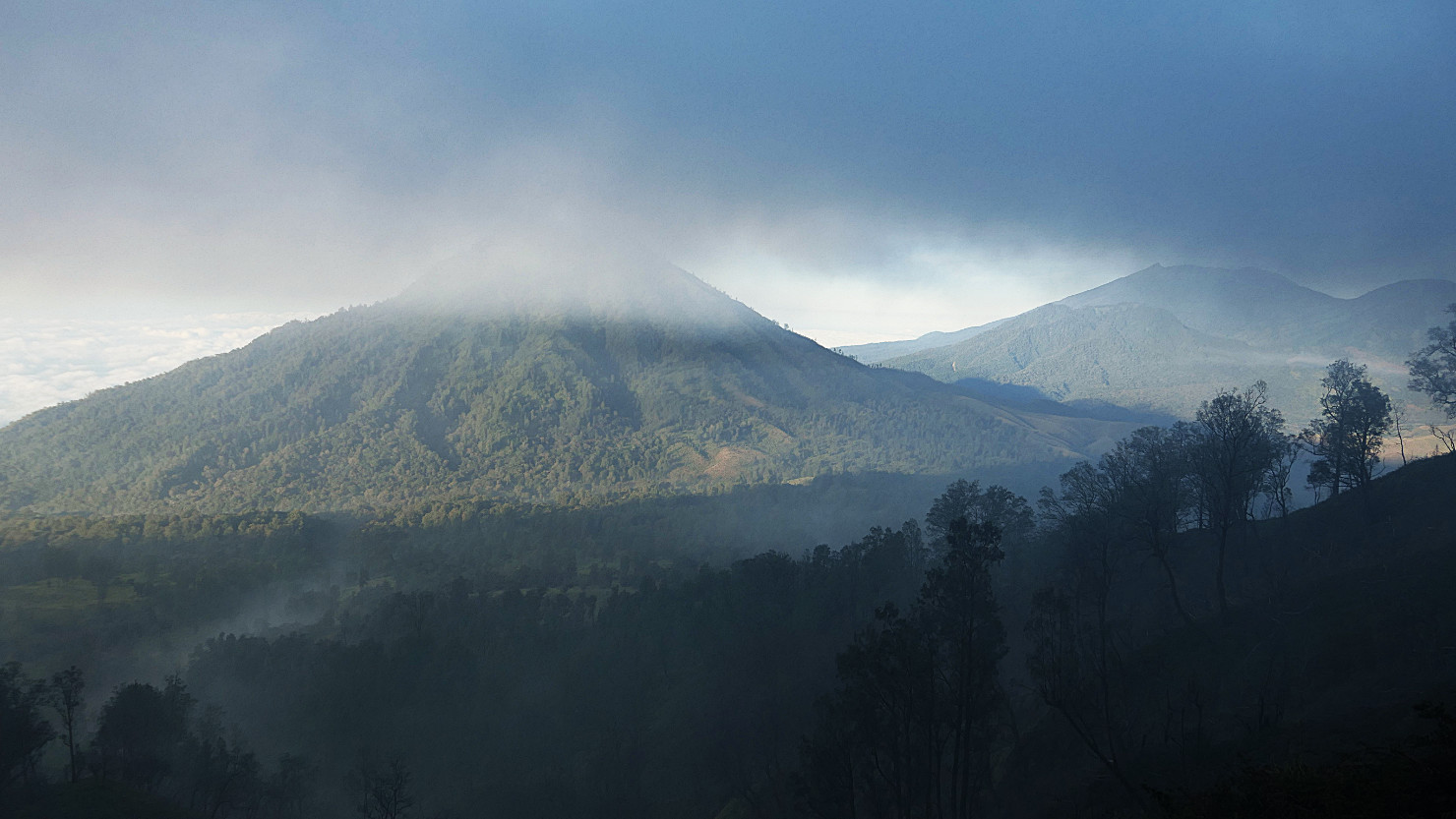
View of a neighboring volcano as we head down the trail.

View of Mt Merapi and a dark sulphur cloud as we head down the trail.

View of the cloud covered city as we head down the trail.
